

Two weeks ago I wrote about where to put 70% of your AI budget in 2027. This week I want to zoom out (yes, more budgets!) and look at what those lines add up to.
I think they add up to a new system. And the gap between what companies spend on AI and what they get back says we need one.
The gap between AI ROI and AI investment keeps growing
Nearly nine in ten companies now use AI regularly in at least one function, according to McKinsey’s 2026 State of AI survey. Only 37% say it has added anything to EBIT. Last year that number was 39%.
Meanwhile, 65% of CFOs said they’d increase gen AI investment, up from about a quarter two years earlier.
So the money going in keeps climbing, and the share of companies seeing a return holds flat.
It’s 1987 all over again, this time with AI
In 1987, the economist Robert Solow wrote, “You can see the computer age everywhere but in the productivity statistics.” Companies were buying PCs, and he couldn’t find the payoff in the numbers.
So what changed? Companies built a system around the PC. Help desks showed up in the 1980s, and by 1988 there were enough of them to start a professional group, the Help Desk User Group, later the Help Desk Institute. IT departments grew. People got trained. Somebody decided which machines and software the company would support.
And the work changed. When Erik Brynjolfsson, Lorin Hitt and Shinkyu Yang studied it, each dollar of computer capital went with more than five dollars of market value. The difference came from what companies built around the computers: training, broader jobs, self-managing teams.
In the book Hyperadaptive I put it this way: without that support, you’ll see “no more results than giving someone a PC and not teaching them how to turn it on.”
The support system built around the PC had to be named, permanent roles and structures, because the PC kept changing. New models of PCs came out. Laptops emerged. Software got updated. Someone had to keep up.
Consider Building an AI Learning Flywheel
AI is changing faster than most other technological revolutions. METR found the length of software tasks frontier models can complete has doubled about every seven months since 2019.
That’s what makes it so different. Speed and scale. A one-time rollout, including one-time training, won’t hold. Every new model means new things to learn, agents to retest, guardrails to revisit and workflows to rethink. Keeping up with that means new roles and new wiring.
The PC’s system was mostly support: keep the machines running, answer the calls. AI needs a system that also keeps people learning. In the book I put the shelf life of technical training at about six months with AI. So a training program won’t hold. You need a flywheel.
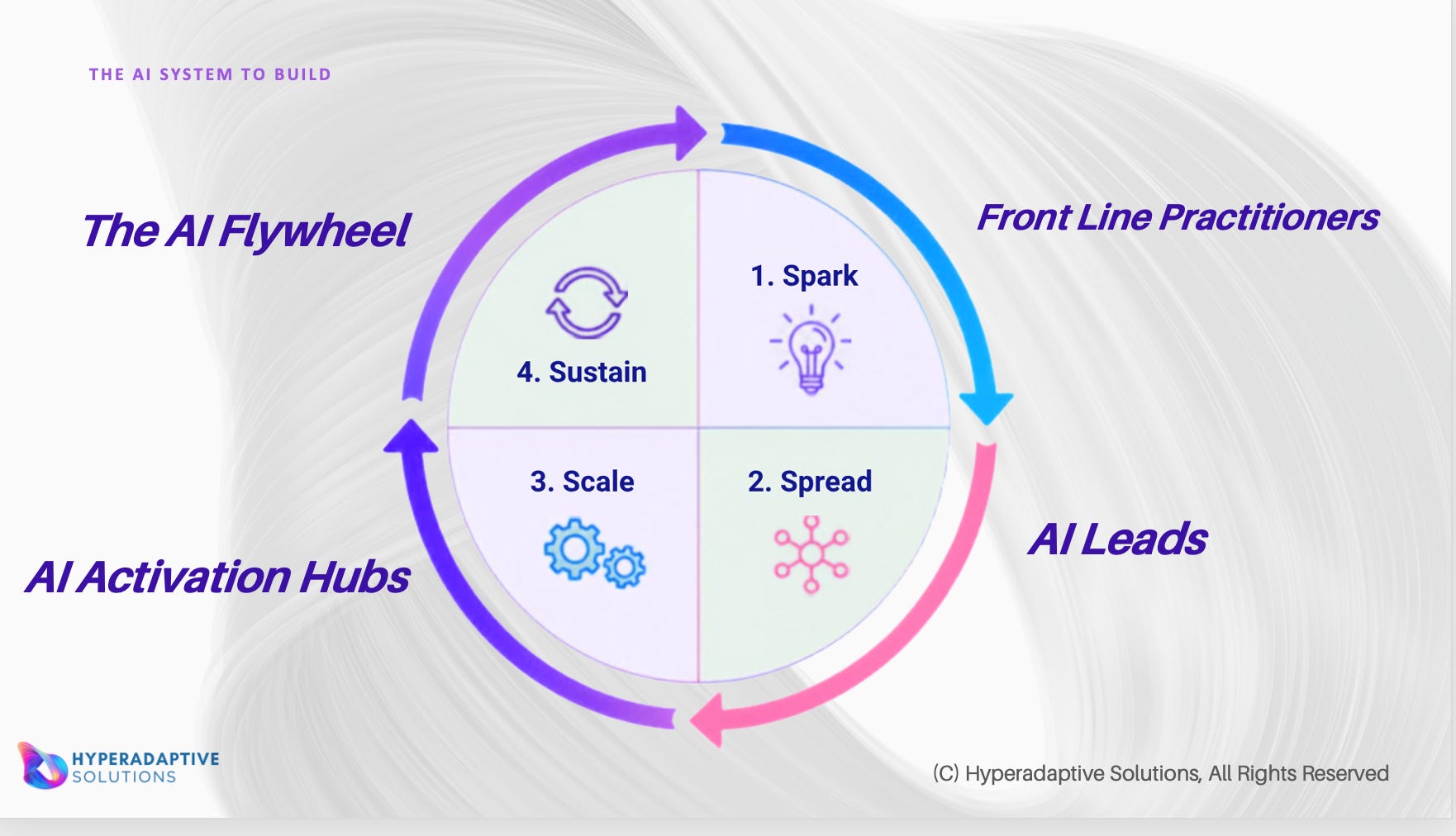
Mine has four parts: spark, spread, scale and sustain.
Spark. Someone gets a real result on real work. That takes adoption (finding the use cases, time to experiment, making AI the easy path) and measurement (a baseline, so the result shows up as a number).
Spread. That result travels to the next team. This is the step most organizations don’t build on purpose, and it’s what AI leads’ time pays for: people in each function who carry what worked to their peers.
Scale. Now it crosses functions, which takes shared infrastructure. The Learning Arena gives people a place to practice on their own work. The governance network answers “Is this a green light?” in each function. And workflow redesign changes the work around the tool. (That’s what made the PC pay off, too.)
Sustain. The models keep changing, so the wheel has to keep turning. Maintenance keeps every agent current when a vendor or model changes, and your leads turn each new release into short updates for the people who need them. Then someone sparks the next result.
Adoption, measurement and maintenance travel with each project. The other four keep the wheel turning for every project, so no single project budget picks them up. Those are the lines that need an owner.
Funding the system in 2027
AI isn’t going away, and it isn’t slowing down. So the 2027 budget question is who owns the system around the tools.
In Chapter 5 of Hyperadaptive, I recommend cross-functional resource sharing: pooling resources across budget boundaries when AI work spans departments. That pool is a natural home for the four shared lines. Who holds it? Does each function chip in, or does it come off the top?
And if you’d like support building the flywheel, that’s what Hyperadaptive Solutions is all about:
Spark with the Applied AI Workshop
Spread with the AI Leads Accelerator
Scaled & Sustain with the AI Activation Hubs Blueprint
Here’s what I’d try before your request goes to finance. Think about where you are at on the flywheel and where you are getting stuck. Then think about how to fill that gap. Any gap is likely an area that needs an owner.
If you’d like to work through it with other leaders in the middle of budget season, join the next cohort of Running Hyperadaptive Organizations: two mornings, Tuesdays Dec 8 and Dec 15, 9 AM to noon MT, on Zoom. $797, 15 seats.
So who’s your help desk for AI?
Melissa, the help desk comparison works because it moves the budget conversation from licenses to the roles and people around them. Your point that adoption, measurement and maintenance travel with each project, while the shared lines need an owner, is the part a CFO should read first. I believe the spread step deserves funding before the other three. A result that stays inside one team never reaches the budget review that decides whether the next one gets paid for.
This is a great article! I will be sharing it on the socials.