

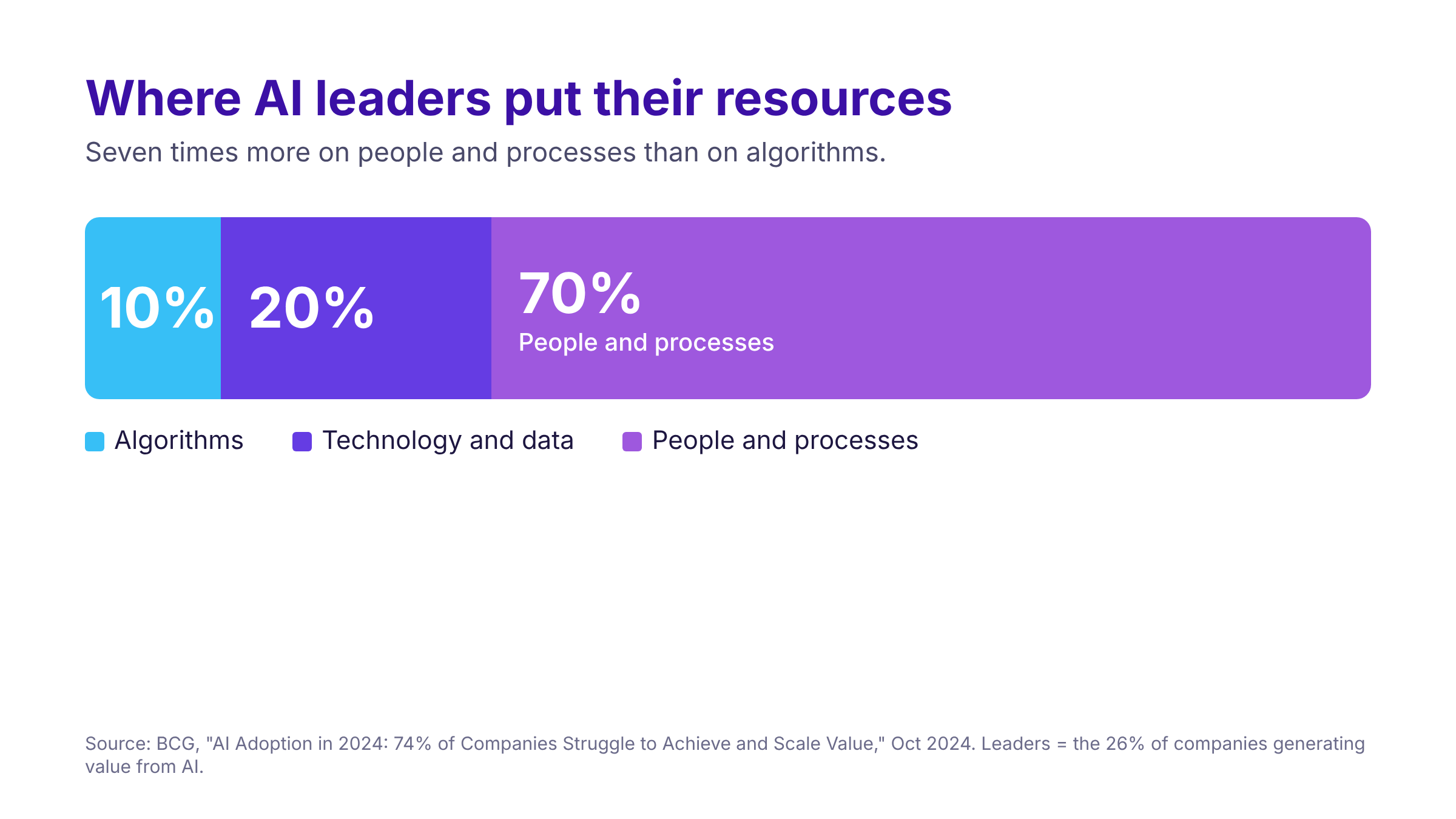
BCG looked at the companies getting real value from AI. The leaders put 10% of their resources into algorithms, 20% into technology and data, and 70% into people and processes. Meanwhile, 74% of companies have yet to show tangible value (hint: they aren’t the leaders…).
Now let’s look forward to 2027. In a CloudZero survey of 252 US finance leaders this fall, 87% are raising their AI budgets. 61% say they’re already spending more than they can justify with measurable outcomes. (CloudZero sells AI spend software, so read it with that in mind.). Ouch.
Also ouch: 38% say this year’s AI spend came out of headcount or hiring budgets.
We steal from the people budget to fund technology. Only to find out that people are foundational to successful technical implementations. 🤦🏼♀️
The budget goes up, the proof doesn’t, and every quarter we pay for licenses that aren’t delivering the value they could.
What happens next fall when your CFO asks what you got?
Investing 10x alongside of AI tech (wait…what?)
Researcher and economist Erik Brynjolfsson suggested that organizations historically invest 10 times as much in the intangible organizational assets surrounding IT as they do in the physical technology. His research highlights that that information technology can fundamentally alter the very nature of work.
Such a transformation, however, often requires that an organization remake its basic structure and processes. Whose budget pays for that? And what does this investment look like?
In the beginning, these often look like orphaned lines. They’re the enterprise-wide people investments with no project to attach to. But without them you get random acts of AI: AI activity that isn’t tied to results.
Eventually, the orphaned lines map to an AI Transformation Office, an AI Reinvention Office, or ongoing AI efforts. The coordination layer that keeps AI installed and updated in the organization, measures its success.
AI’s Missing Coordination Layer
The Six AI Areas to Fund in 2027
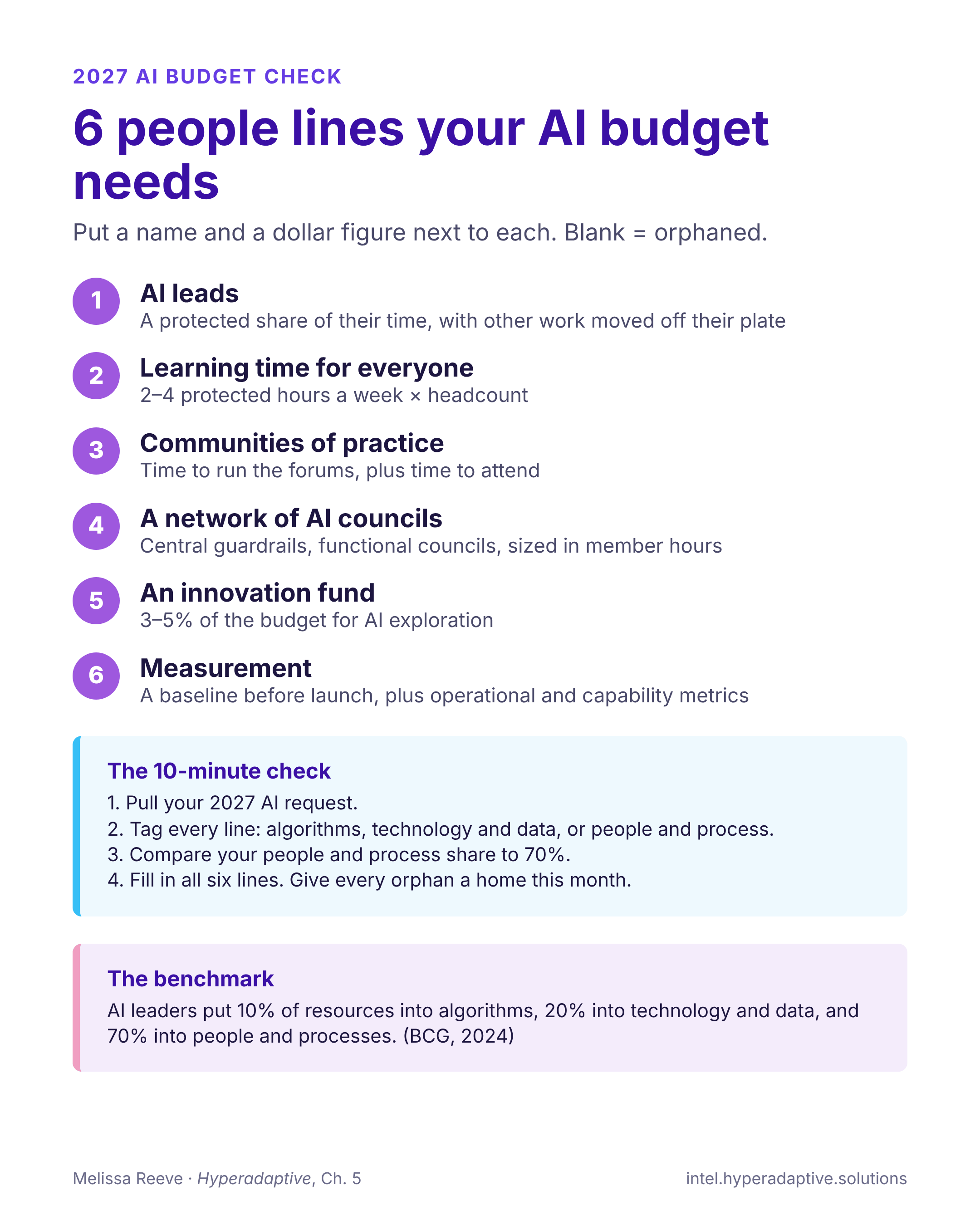
Chapter 5 of my book lays out what the foundation for AI needs. Here are the six people lines I’d put in every 2027 AI budget, and how I’d size each one.
AI leads. Named people in each function who help their peers. Size it as a share of their time, and move other work off their plate to make room. What share? 10%? 20%? Decide, then protect it. (Activate it with the AI Lead Accelerator)
Forums for Reinvention. It doesn’t happen on its own. Reinvention comes with blockers: connectivity, security, governance, maintenance. Groups need time to reinvent entire workflows together to see the benefits, explore dependencies, and resolve blockers. Put in real time and dollars toward this. (Our version is the Applied AI Workshop).
Communities of practice. Forums where people find each other and share what’s working. Size the time of whoever runs them, plus the hours people spend in them.
A network of AI councils. One central council setting guardrails, smaller councils in each function interpreting them. Size it in member hours. (Need help? the Governance Network Workshop may be what you are looking for).
An innovation fund. 3% to 5% of your departmental or organizational budget, set aside for AI exploration, so early experiments don’t have to prove ROI on day one.
Measurement. A baseline before launch, then two sets of metrics: the operational gains, and the capability you’re building. Size the analyst time to run both.
Where are You Spending Your AI Budget?
Before your budget locks, try this:
Pull your 2027 AI request. Tag every line: algorithms, technology and data, or people and process. Add up the people and process share. How close is it to 70%? Put a name and a dollar figure next to each of the six lines. Any line still blank is an orphan.
If the people share comes back small, that’s your conversation with finance this month, while the numbers can still move.
The check shows you where your orphans are. Hyperadaptive shows you how to fund them, from the innovation fund in Chapter 5 to the full funding model in Chapter 9.
So, who in your organization owns the line for AI learning time?
Need More Guidance?
Get a sense of the AI-Learning Flywheel and how to build an always-on learning here. See the order in which to build out your people layer on this page.
The part that stuck with me, Melissa, is how little shared language teams still have for what good digital service looks like once AI enters the loop.
the orphaned budget lines idea for people work is a handy way to frame it, never thought of funding it like that