

So I’m on a sales call, and the question comes up. “Why can’t we just put our processes that we have mapped into Claude and have it reinvent an AI-native one?”
I hear some version of this all the time. Oh, just have AI analyze the workflow. Wave the magic wand.
But it’s not that easy. And it’s not easy for a bunch of different reasons.
Last month I got to watch those reasons show up live. I was running an Applied AI Workshop at a public life-sciences company with teams in Europe and the US. Two sessions, about three hours each. Together, we scoped a tight workflow that represented the most rule-based thing they do.
In session, we started pulling the process apart, like we always do. Those on the front line had great ideas for reinventing the work. Then, we went to execute, and the room ran into headwinds:
Every country had different processes.
AI guardrails and governance looked different in Europe than in the U.S.
As a public company, we ran into SOX compliance and data issues.
Missing connectors stalled out basic automations.
The team pitched ideas and voted with dots. The winner was to create a Jira ticket automatically, then keep it updated every time something changes, “so you never need to do a Jira ticket again.” Wouldn’t that be nice??
Everybody wanted it. Lots of dots.
Then we asked what it would take. Their internal tech team doesn’t support the system feeding Jira, so an outside partner would be needed to build those integrations. That same integration specialist showed up on three different ideas.
I asked, “Am I hearing you right that the area that has the most pain and the most dots is where we’re stuck?”
“Yeah.”
We want some steps to be human on purpose
In theory, AI could automate most of the workflow they identified. That doesn’t mean that AI should automate it.
A team member explained that automating “removes the human element and the conversation that seems to get sparked from it.” And “that conversation has to happen because it keeps the experience intact.”
Another area kept human was approvals. The business partner said fixing those approvals was “more of a human capital and strategy issue than an automation issue.” Someone else added, “We try every year, and it doesn’t work.”
Would an outside team ever have found that? I doubt it.
Does reinventing work for AI get easier?
Someone asked, “Is [this difficult] because this is the first one and it gets easier after this? Please say yes even if it’s not the truth.”
Yes! It does get easier, because you start to see the patterns. You build the connectors. You start to address the governance blockers.
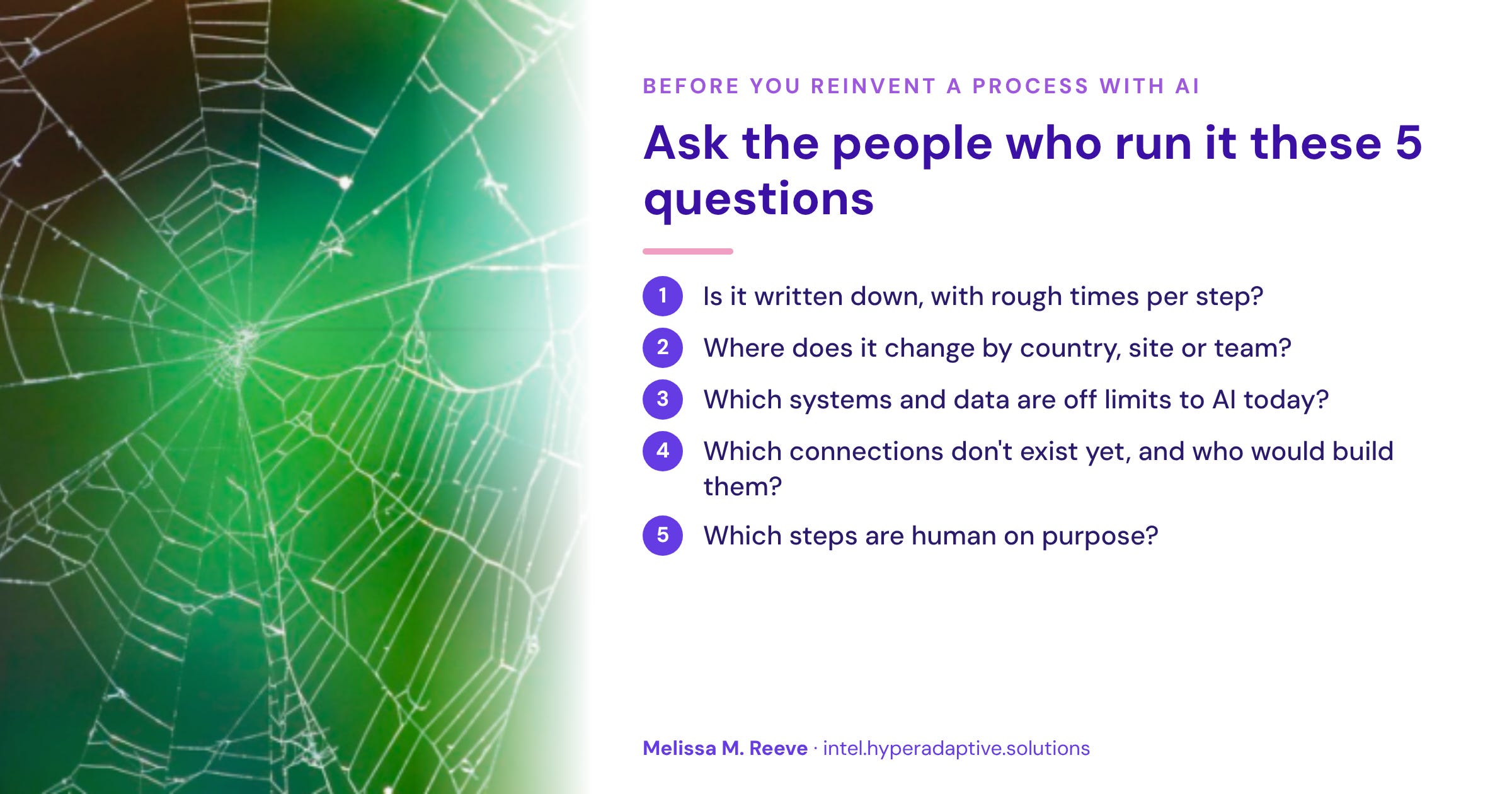
That morning I’d put up a picture of a cobweb. Claude can spin you a brand-new web, representing an AI-native ideal. But the people living in the old one are the only ones who know where it’s torn, what’s holding it up, and how to address the headwinds
My co-facilitator Matt put it this way: the holdup isn’t that the technology can’t do it. “It’s always the people.”
Lessons from Business Process Reengineering
Remember business process reengineering in the 1990s? Companies brought in outsiders to totally reinvent their processes as they implemented ERP systems. Then the outsiders walked away.
And there were a bunch of little gotchas. Some never got caught. And because the new processes were imposed on people, a lot of folks never absorbed them or understood them.
Michael Hammer, who helped start the whole movement, owned it. He told the Wall Street Journal in 1996, “I was reflecting my engineering background and was insufficiently appreciative of the human dimension.”
I’m watching the same thing happen again. Companies bring in people with engineering skills to reinvent the processes, and then they dump the new processes on the team.
And even if that works... what happens in six or 12 months when the models change again? Do you bring the engineers back every time?
The fix: teach the team
This is why I’m such a proponent of the front line reinventing their own processes, a piece at a time. The skills are durable. How to look at a process. How to find the highest-value use cases. How to figure out what you can and can’t build today.
On day two the team built four things they could ship without touching the blocked systems. One was a dashboard to visualize where individuals were at in the process. They asked Claude what it would save in communicating status back and forth. About 150 hours a year, roughly 19 working days.
A lead pushed back right away that we couldn’t just harvest the 19 days. “Time saved is not money saved. Maintenance is not counted.” His number landed closer to 110 hours. I love that. That’s the judgment you want in the room.
Midway through, the person driving the build added a line to the prompt: “We don’t need to build this all at once. Let’s get one module locked in, then expand.” Love it!
By the end, the leader who’d pitched the Jira idea described what they’d learned as “the concept of taking down a process, splitting out where we think we can put AI, and then building something.” Someone else said some workflows may need “tearing down” and rebuilding “from the ground up.”
They got there themselves, after they’d seen the headwinds.
Try this with one process
Get the people who run it together, and before anyone redesigns anything, ask:
Is it written down, with rough times per step?
Where does it change by country, site or team?
Which systems and data are off limits to AI today?
Which connections don’t exist yet, and who would build them?
Which steps are human on purpose?
In Chapter 6 of Hyperadaptive, I walk through how to run mapping sessions with your AI Leads and the people who do the work. They come out with “a personal investment in both current operations and future improvements.”
The function I was working with runs more than 200 processes. This team looked at one. 😅 I told them they could do this two or three times a year and find something new every time, because the models, the connectors and the access keep changing.
Now you know why we need people to own their own processes. They are the ones who will continually reinvent them as the AI models change.
The book shows you how to set up that first mapping session. So who on your team could run the next one on their own?
Need Help Getting Started?
The Applied AI Workshop is just one quadrant of the AI Learning Flywheel, Attendees work through one or more workflows, learning the durable skills they need to reinvent processes again and again, including:
Process mapping | AI use case identification | Blocker identification & resolution | Governance | Building with AI | Measuring Impact | Taking AI processes live
Find more information at: https://hyperadaptive.solutions/programs/applied-ai-workshop