

A note before we begin: this is the first of my monthly deep dives, a longer read than the usual weekly field report. I wanted one of these to follow a single thread all the way down, from a pin factory in 1776 to the question you are sitting with right now about your own org chart. Pour a coffee. I think it earns the twelve minutes.
Someone I have known for the better part of a decade is one of the most interesting people I get to talk to. He is a working musician, the kind who still plays gigs on weekends and hears arrangements in his head while the rest of us hear noise. He also holds a computer science degree. And for the last several years he has made his living as an account executive, carrying a quota, running a pipeline, closing deals.
When he was starting out, he had to choose. Not because he lacked the range to do more than one thing, but because the world he was entering was built to reward one thing at a time. You pick the lane that pays, you get good at it, and the other parts of you become hobbies. He chose sales because sales was the lane with a clear price on it. The music and the code went into the evenings and weekends.
I think about him a lot lately, because the organizational structure that made him choose a lane is the same structure that will buckle under AI.
In a world where the lanes are dissolving, what was the point of the lanes in the first place?
Why We Drew the Lanes at All
To answer that, it helps to go back to where the lanes were first drawn so deliberately that someone wrote them down.
In 1776, Adam Smith opened The Wealth of Nations by walking through a pin factory. He counted ten men. On their own, each one fumbling through the whole job from wire to finished pin, he reckoned a single worker might make one pin a day, and certainly not twenty. Divided into about eighteen distinct operations, one man drawing the wire, another straightening it, a third cutting, a fourth pointing, those same ten men produced 48,000 pins in a day. Specialization did not make the workers smarter. It made the system enormously more productive.
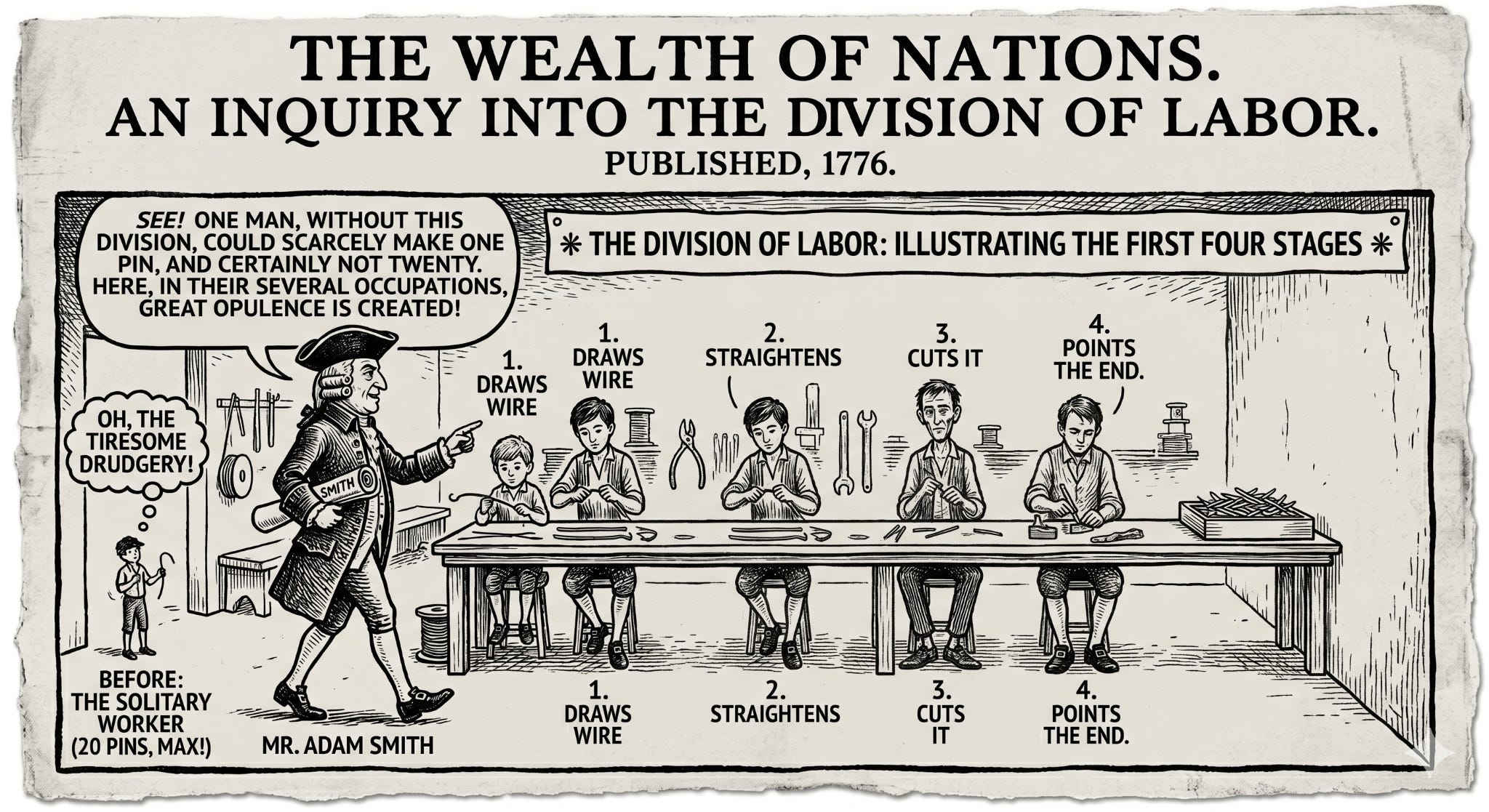
For a long time we told the story as Smith told it, as a story about output. But a generation later, a British mathematician named Charles Babbage noticed something Smith had walked right past. In 1832, in On the Economy of Machinery and Manufactures, Babbage pointed out that dividing the work did not just raise the volume of pins. It changed what you had to pay for them. If one skilled artisan made the whole pin, you paid that artisan’s full wage for every step, including the easy ones a child could do. Break the job apart, and you could buy exactly the amount of skill each step required, and no more. Cheap labor for the simple steps, expensive labor only where the work was genuinely hard.
The division of labor was never only about productivity. It was about the economics of skill. We split jobs into pieces because it let us match the price of the person to the difficulty of the task.
But, here’s the conundrum. On the one hand, it is more economical to ‘keep people in their lanes’ and ‘match the price of the person to the difficulty of the task.’ But, on the other hand, people can almost always do more than their lane allows. The lane is a financial decision dressed up as a job description. Frederick Taylor took that decision and made it a science, timing every motion, separating the people who think from the people who do. By the time the assembly line was humming, lanes defined the architecture.
So the Lanes Got Narrow, Right?
The trouble with an architecture is that it outlives the reason it was built.
We are long past pin factories, and yet most organizations are still drawn as a grid of lanes. Marketing here, legal there, sales down the hall, engineering on another floor entirely. We hire people into a box, we evaluate them on how well they stay in it, and then complain about the ‘lack of innovation’ in our organizations. The account executive who can also read a data model, or sketch the product, or hear the music in a brand, has nowhere on the org chart to put those other selves. There is no column for the intersection.
For over a hundred years, that trade was worth it. The economics held. You genuinely could not afford to let everyone do everything, so you accepted the narrowing as the price of scale. The question becomes, when both AI and humans get adjacent competencies, what happens to the lanes?
And AI Doesn’t Live in a Lane
Watch what AI actually does inside a real team, and you see the lane constraint lifting from two directions at once.
From one direction, it lifts people into competencies that used to take years to earn. The clearest evidence I have seen is a study by Erik Brynjolfsson, Danielle Li, and Lindsey Raymond, who looked at more than 5,000 customer support agents using a generative AI assistant. On average, productivity rose about 14 percent. But the average hides the real story. For the newest, least experienced agents, the gain was 34 percent, while the most experienced agents barely moved. The tool worked as a kind of knowledge equalizer, taking what the best people knew and quietly handing it to everyone else. The novice could suddenly operate in the expert’s lane.
From the other direction, AI moves into adjacent work itself. The account executive does not just get better at selling. He uses AI to build the rough version of the dashboard he used to wait two weeks for, to draft the contract language he would have routed to legal, to mock up the campaign he would have briefed to marketing. We have seen a version of this movie before, with DevOps, which did not erase the work of shipping software so much as it changed who was allowed to do which parts of it. Toyota and Mercedes-Benz have been cross-pollinating factory-floor workers with data science skills for exactly this reason. The lines around who-can-do-what stop being walls and start behaving like membranes.
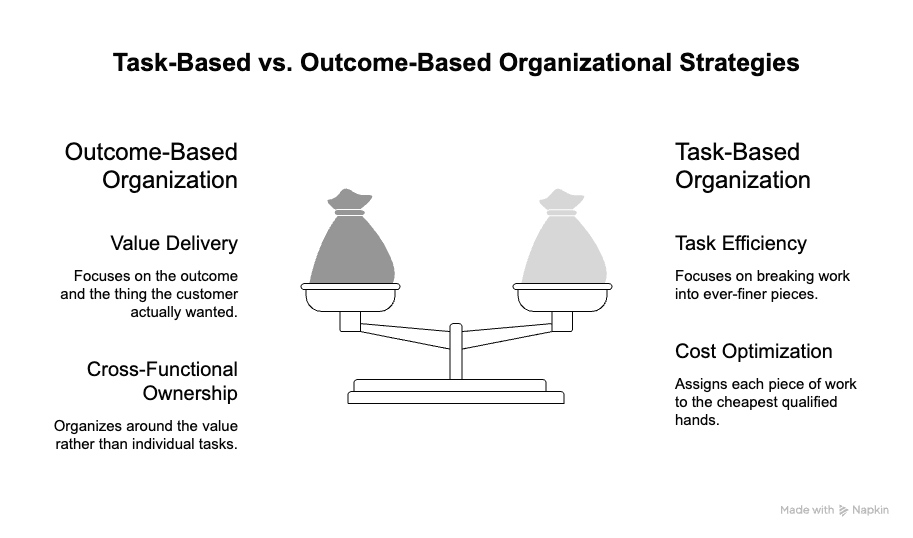
Which brings me back to Babbage, and to the question I do not think any of us can answer cleanly yet. Babbage’s whole insight was that you divide the work so you can pay less for the easy parts. But AI is now doing the easy parts. So when the cheap, simple steps are absorbed by a machine that costs roughly the same whether it drafts one email or ten thousand, what exactly are we still dividing, and why? Is the goal still to break the work into ever-finer pieces and assign each to the cheapest qualified hands? Or is the goal to stop organizing around tasks at all, and organize around the outcome, the value, the thing the customer actually wanted?
I do not have a tidy answer, and I have made my peace with that. I think the honest position right now is that the answer is in flux, and that the leaders who do best will be the ones comfortable saying so. When did your organization last ask whether a given role needed to be a single lane at all, rather than just asking how to make that lane more efficient?
The most useful reframe I have seen on this comes from Satya Nadella, who has been arguing that every firm now runs on two kinds of capital. There is the ‘human capital’ of its people, their judgment and relationships and pattern recognition, and there is the ‘token capital’ of the AI capability the firm builds and owns. His claim is that human capital does not get less valuable as the token capital grows, it gets more valuable, because without human direction you just have compute running in circles. So the thing that actually matters is not the task and not the model, it is the loop between people and AI that keeps compounding what the firm knows. You can offload a task, or even a whole job, but you can never offload your learning. And a loop that keeps compounding is not a machine you finish building. It is something that grows.
We’ve Been Building Machines, and Machines Age Badly
Faced with all this, a lot of leaders are reaching for a new org chart. Flatten the layers, cut the middle, redraw the boxes around AI, and declare a new operating model. And I want to be fair to that instinct, because some restructuring is genuinely overdue, and 82 percent of executives in IBM’s latest research say their functional silos are actively blocking value.
But redrawing the grid is still grid thinking. The most extreme version of this is the company that cuts half its workforce on a spreadsheet logic of profit-per-employee, the way Block has, treating the people who walked out the door as cost rather than as the living memory of how the place actually works. Even setting aside what I think of that as a way to treat human beings, it is shortsighted on its own terms. You cannot download institutional knowledge back into a building after you have shown it the parking lot.
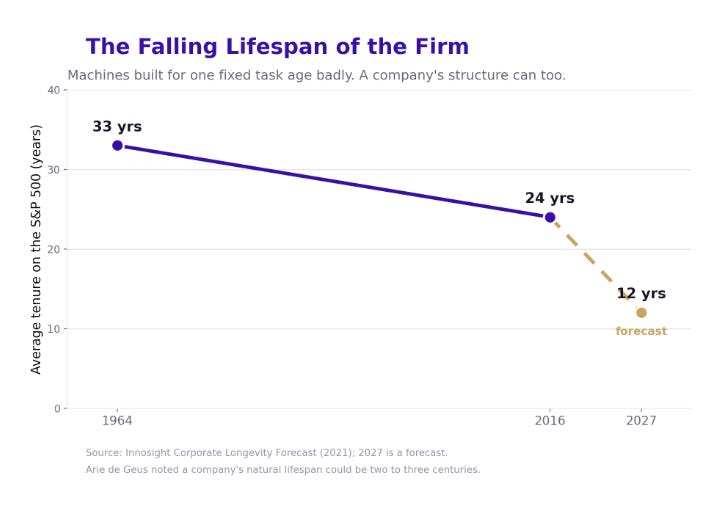
The deeper problem is that machines, including org-chart machines, are built to do a fixed thing well, and the moment the environment changes they become precisely wrong. We have a hundred years of evidence for this. Arie de Geus, who ran planning at Shell and wrote The Living Company, found that the average corporation dies well before its twentieth birthday, even though there is no natural reason a company could not live for two or three centuries. The tenure of companies in the S&P 500 has fallen from thirty-five years in the late 1970s toward fifteen. The machines we build to be efficient keep dying young, because efficiency and adaptability are not the same thing, and we kept designing for the first one.
Émile Durkheim saw the better half of this back in 1893. He described societies moving from what he called mechanical solidarity, where people cohere because they are all the same and interchangeable, to organic solidarity, where they cohere precisely because they are different and depend on one another. He reached, deliberately, for the language of a living body, parts that are unlike each other but bound together. It was the right metaphor. We just stopped at the organ and never got to the organism that grows.
Better to Grow Like a Forest
Walk into a forest and you are looking at the most successful organizational structure on the planet, one that has run continuously for hundreds of millions of years. A tree does not draft a new operating model every spring. It sheds the leaves that have stopped working, holds the structure that still serves, and grows into the light that is actually available this year. It renews itself without ever ceasing to be itself.
That is not a poetic flourish, it is a body of science. John Holland and his colleagues at the Santa Fe Institute spent decades studying what they called complex adaptive systems, the family that includes ecosystems, immune systems, cities, and markets. What those systems share is instructive for anyone running a company right now. Their boundaries are semi-permeable rather than rigid, more like the edge of a niche than a wall. They are made of many agents adapting locally. And their order is not designed once from the top and frozen, it emerges and re-emerges as conditions change. They are built to keep becoming, not to keep still.
So the goal, I have come to believe, is not to arrive at a new operating model and plant a flag. A new fixed structure is just tomorrow’s legacy system. The goal is to build an organization that can keep re-forming its own boundaries, the way a forest keeps re-sorting which species thrive in which clearing. The structure becomes a verb. You are not designing the final shape. You are designing the capacity to keep finding the next shape.
This is also where Nadella’s framing gets concrete and practical. He describes the real test of a firm’s sovereignty in this era as the ability to swap out a generalist model the way you would replace a worn part, without losing the ‘company veteran’ expertise your people and your systems have accumulated. The tree drops the leaf and keeps being the tree. The learning stays even as the components turn over. That is what separates a structure that is alive from one that is merely assembled, and it is why the firms that start building that compounding loop early will be very hard for a swapped-in competitor to catch.
If that sounds abstract, notice that it is exactly what my friend the musician does instinctively, and what AI now lets a whole organization do. Given tools that hand him adjacent competencies, he stops being an account executive who happens to play music and code on the side, and starts being a person who brings all of himself to whichever problem is in front of him this quarter. The lane dissolves into a living set of capabilities he can recombine. That is the real change AI makes possible, scaled from one person to ten thousand.
So Where Does a Leader Actually Start?
The honest catch is that you cannot become a living system by reorganizing into one on a Tuesday. That would be the machine move again, one more big redesign imposed from the top. Renewal is grown, not installed.
So I would start small and on purpose. Pick one seam in your organization where the wall between two functions is clearly costing you, the place where work bounces back and forth and value leaks out at the handoff, and make that boundary deliberately permeable for ninety days. Give a few people the tools and the explicit permission to work across it. Watch what they make at the intersection. Then do it again somewhere else. This is the logic behind the five-stage Hyperadaptive model I wrote about in the book, where the stages themselves are becoming well understood and the real secret is in the support structures that let change spread and stick. Slow down to speed up. You are not trying to reach the destination this quarter. You are trying to build the thing that can keep reaching new destinations on its own.
Because that, in the end, is what I think AI-native actually means. Not a company that has installed the most tools, and not a company that has cut the most heads to flatter a ratio. A company that has gotten good at renewing itself, that treats its own structure as something living and tends it accordingly. The pin factory taught us to divide a person into the cheapest useful pieces. The forest can teach us how to let people, and the organizations they make, grow back whole. I think the companies that learn the second lesson are the ones still standing in thirty years, and I would very much like yours to be one of them.
Taking the Next Step
If you are leading AI initiatives and wanting to explore how to become AI-Native in a structured way, consider attending the Running Hyperadaptive Organizations class.
And if you want the full map of the journey, the book Hyperadaptive: Rewiring the Enterprise to Become AI-Native is now out.
Great article, as always! Couldn't agree more and, in my case, I had used the marketing technology and the Brazilian wetlands analogy so marketers can understand they will need to have adaptive systems as well...
The Babbage insight is the most important reframe in here. Smith gets quoted constantly. Babbage almost never does but he's the one who identified that the division of labor was fundamentally a pricing mechanism, not just a productivity one. When AI absorbs the cheap steps, the economic logic of the lane structure disappears. What we're left with is the habit of lanes, not the reason for them.
"Redrawing the grid is still grid thinking" That's the line that should end most org redesign discussions. A new chart with the same underlying logic is just tomorrow's legacy system, and you've burned the transition cost to get there.
I write about production AI systems and distributed backends. Worth a subscribe here too.