


Last week, Anthropic published a study of its own workforce. The company that builds Claude measured what happened to its jobs as agents spread through every team.
It reads like a field report of Stage 3 (AI Automations) of my book.
In Hyperadaptive, I wrote that when automation takes hold, jobs shift from people doing the work to people managing the machines doing the work. I’d seen it with DevOps, when the software delivery pipeline got automated. FedEx also exemplified it, when they trained 500 team members to run the automated sorting system and hired 85 new people to maintain it.
The report is early. It covers one company, a fast-growing one that tripled in size last year, measuring a product it sells. The authors recognize this and describe what they saw without claiming AI caused it. So treat it as an early signal. But it’s the most detailed look at a company that’s further down this road than yours, and the signals are worth considering.
Three of them stood out to me. Each one comes with a lesson for leaders.
Doing the work vs. running the agents
The first signal is the shift I wrote about. Anthropic calls it meta-work: writing skills and plans for agents, reviewing their output, building dashboards to monitor agent pipelines, and documenting how the work gets done.
In fall 2025, meta-work made up 10% of employees’ interactive sessions with Claude. By spring 2026, it was 22%.
More than double in about six months.
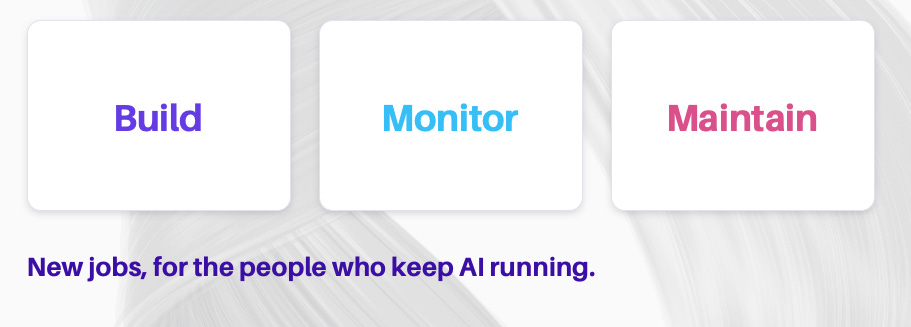
In an April survey, 20% of employees described their role shifting from doing work to managing Claudes. For the past two years, I’ve said, “when automation takes hold, jobs shift from doing the task to building, monitoring, and maintaining the automations that do the task.”
A New Type of ‘Management’?
The engineers sound like new managers. One described “an army of Claudes, with every one asking for my attention.” Commits per engineer ran about five times the pace of six months earlier. In March 2026, agent work hours passed human work hours for the first time. Agent hours now outnumber human hours six to one. (Six to one!)
One non-technical employee said “that the 20% of my job that was strategic becomes 90% of the job.” Sales calls, interviews, cross-functional alignment... the people parts of the job grew to fill the space.
Personally, I am relieved that more of my job is spent thinking vs. aligning boxes on a PPT deck.
Meetings grew too. The median employee spends 20% more time in meetings than a year ago. Even technical individual contributors are up 16%. When agents produce more work, humans spend more time aligning on it.
Not surprised, TBH.
The researchers also describe what this feels like from the inside. Workers “codify their expertise for the machine” and “see their work routines constantly roiled and disrupted.” That’s the doing-to-managing shift, described by the people living it.
I keep seeing leaders who think AI will install itself. Guess, what? It doesn’t. The lesson for leaders: if your people are moving from doing to managing, somebody has to teach them to manage agents.
Who teaches a senior analyst to write standing instructions for an agent?
Who teaches her to review fifty outputs in an afternoon without rubber-stamping them?
In the book, I call the people who lean into the work of building “automation imagineers.” Few organizations I work with have named that role yet, let alone built a path into it.
Junior Level Hiring Shrank (a Mistake, IMO)
The junior share of Anthropic’s technical hires fell from 27% to 9%. Junior employees dropped from 21% to 14% of technical headcount since early 2025.
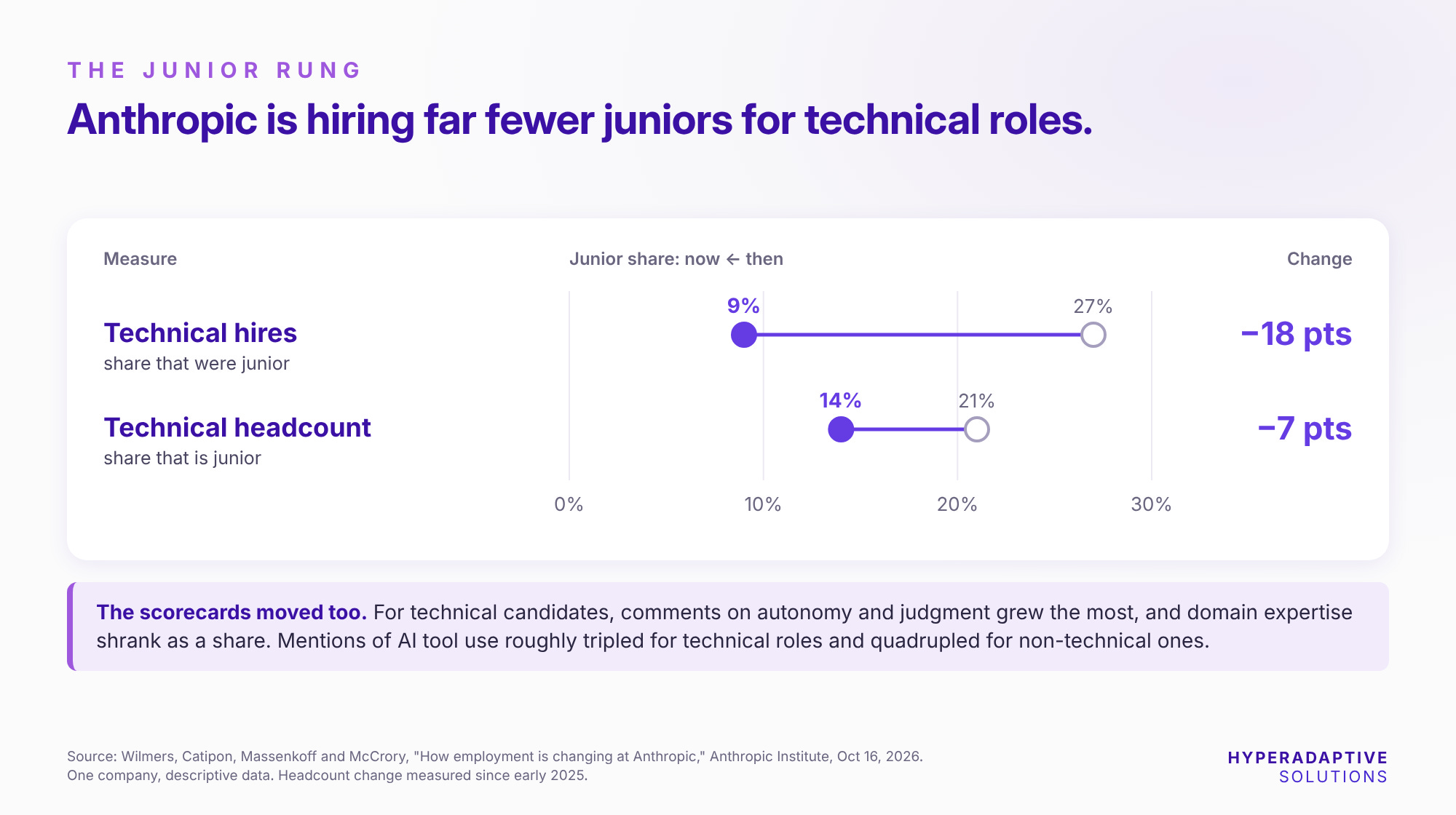
And the company still grew overall. Technical hiring rose in absolute numbers. Hiring for sales, finance and recruiting grew even faster, so the technical share of employment slipped from 61% to 56%.
So where did the junior roles go? The report points at the work itself. Writing code and finding bugs could increasingly be offloaded to Claude, and that’s the work juniors used to learn on. One engineer told the researchers it “basically overnight changed what we were looking for.” Around a third of machine learning managers and a fifth of software engineering managers said they were hiring less because of AI.
The interview scorecards changed too. For technical candidates, comments on autonomy and judgment grew the most, and domain expertise shrank as a share of what interviewers wrote about. Mentions of how candidates use AI tools roughly tripled for technical roles and quadrupled for non-technical ones.
Autonomy and judgment used to be what you grew into after a few years on the job. Now they show up on the entry-level scorecard.
The authors are direct about who absorbs the cost: “Employment protections for incumbents will not benefit those not hired to begin with.” They also note that Anthropic’s own commitments to employees don’t address the slowdown in junior hiring, and they cite earlier research finding that AI-native and AI-adopting firms employ fewer entry-level workers. So this goes beyond one company’s hiring quirk. They’re naming the problem in public, without a plan for it yet.
But, I think this is a mistake. This isn’t the first time we’ve experienced a skill shift.
Where We’ve Seen Skills Shift Before
For a recent talk, I built a slide around a pattern I call “skills shift left.” Skills that once belonged to a small professional class keep moving earlier in life, until kids pick them up.
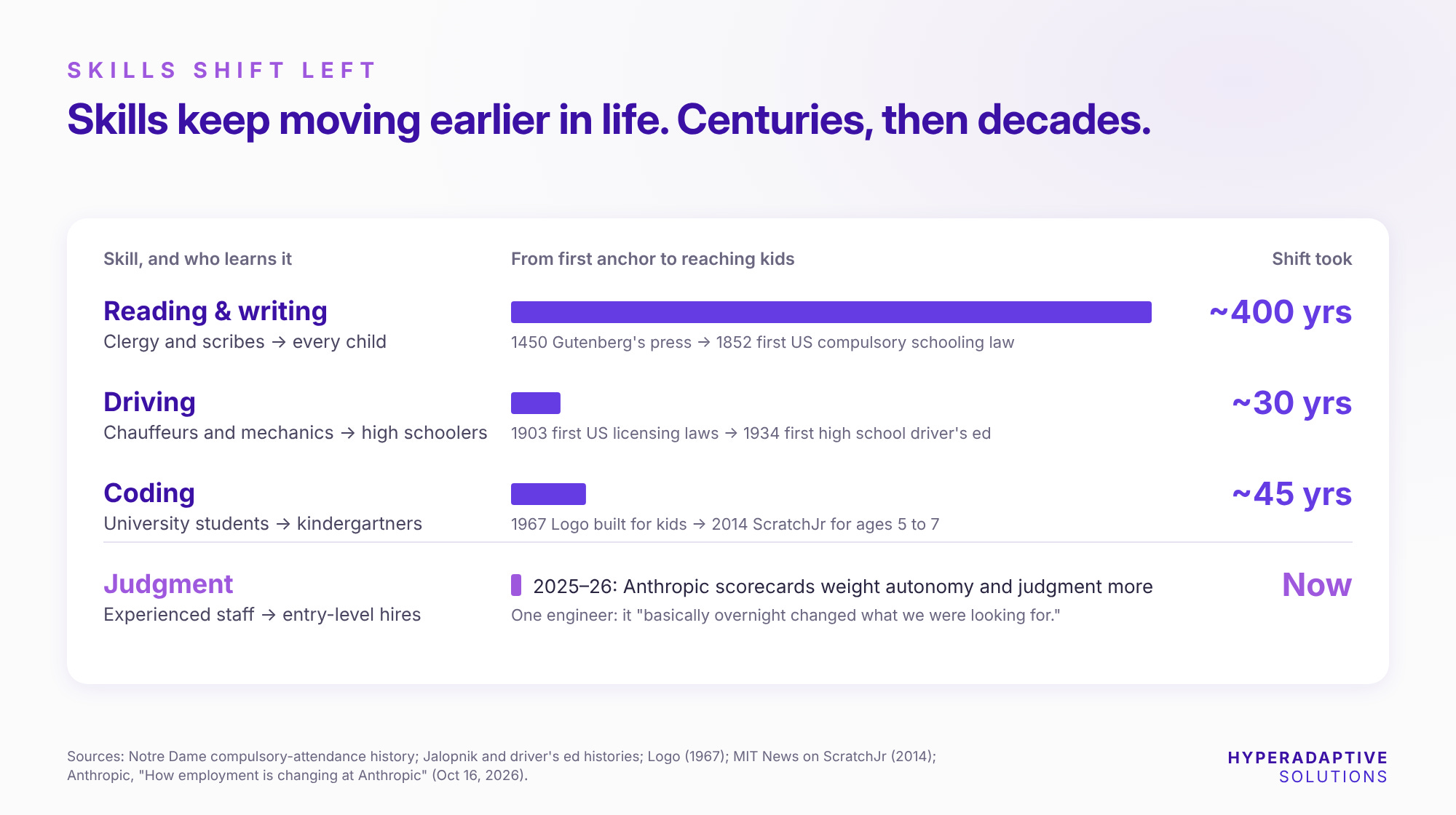
Reading and writing belonged to the clergy for centuries. Gutenberg’s press arrived around 1450. Massachusetts passed the first US compulsory school attendance law in 1852, and every state had one by 1918. Roughly 400 years from a few clerics’ boys to every child.
Driving started with chauffeurs and mechanics. The first US licensing laws came in 1903. Pennsylvania set the minimum age at 18 in 1909, Connecticut allowed 16 by 1921, and the first high school driver’s ed course ran in 1934. About three decades.
Coding started at universities. Researchers built the Logo language for kids in 1967. In 2014, MIT and Tufts released ScratchJr for five- to seven-year-olds.
Centuries, then decades.
Now look at Anthropic’s scorecards through that lens. What’s moving left this time is judgment. The things we used to expect from a five-year veteran, like knowing what good looks like and spotting the subtle error, are showing up in the first-job interview.
Reading moved left because we built schools. Driving moved left because we built driver’s ed. Judgment has always been learned on the job, from someone more experienced, on real work. There’s no classroom catching it. But that doesn’t mean we don’t have solutions.
What We Can Learn from Robotic Surgery
Buried in the Anthropic report is this line: in some roles, workers “are increasingly removed from the object-level work that originally built their skills.”
Surgery ran this experiment about a decade ago.
Matt Beane, who studies technology and work at UC Santa Barbara, spent years inside hospitals as they adopted robotic surgery. He observed hundreds of procedures at five hospitals and interviewed surgeons and trainees at 13 more.
In open surgery, the senior surgeon couldn’t do the operation alone. The attending needed the resident’s hands in the patient, so learning came with the work. You learned because the job took two people.
The robot changed that. With the robot, attendings needed the resident’s help much less. Residents ended up at the bedside clearing smoke, fluid, or stationed at a second console “waiting for a chance to operate.” When they did get a turn, Beane writes, surgeons “helicopter taught.”
Beane’s finding: “Very few residents overcame these barriers.”
The minority who did found workarounds the hospital never designed. They practiced on simulators. They watched recorded surgeries on YouTube. They specialized early in medical school. Some pushed into what Beane calls “undersupervised struggle,” working at the edge of their ability with little expert help. He named the whole pattern shadow learning.
His warning for organizations is that leaders may not know “how learning is actually happening” inside their walls, and that “we may unwittingly improve our way out of the skill we need.”
Swap the robot for an agent and the warning still holds.
Workera surveyed 1,000 employees at large US companies this summer. 46.5% are building skills on tools their employer never provided. Only 26.6% get regular coaching from a manager, and 21.5% get none at all. (Workera sells skills measurement, so weigh it accordingly.)
So shadow learning is already happening inside your organization. The question is whether anyone designs it.
Four Approaches to Teaching Judgment
History does offer some good news. Every time skills moved faster than schools, pairing carried them.
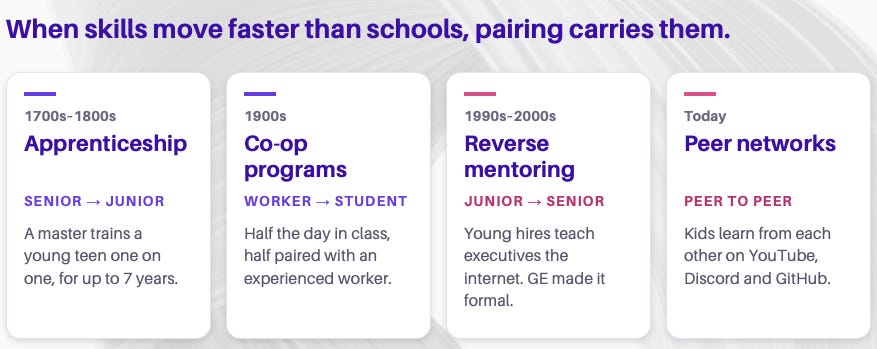
Apprenticeship. England’s 1563 Statute of Artificers set a minimum seven-year term. A master trained a young apprentice, one on one.
Co-op programs. In 1906, Herman Schneider launched cooperative education at the University of Cincinnati with 27 students and 13 companies. Students alternated a week in class with a week on the job.
Reverse mentoring. In 1999, Jack Welch had 500 of GE’s top executives pair with younger employees to learn the internet.
Peer networks. In Stack Overflow’s 2024 survey, 90.4% of developers under 18 learned to code from online resources. 32.2% learned in school.
Senior to junior. Worker to student. Junior to senior. Peer to peer. The direction changes every time, and each one still puts a person who knows next to a person who’s learning.
Inside the enterprise, the peer network has a name. In the book, I describe Communities of Practice as the place people go to process changes, share emerging technical knowledge and solve implementation problems as automation spreads. For a junior hire whose first tasks went to an agent, a Community of Practice might be the best teacher in the building.
Some Jobs Do Go Away. Some Shift.
In 1920, about 4% of young, white, American-born working women were telephone operators. It was a classic first job. As the Bell System switched cities to mechanical dial, the number of young women working as operators in later cohorts fell 50 to 80%. Economists James Feigenbaum and Daniel Gross traced what happened next.
The later cohorts did fine. They found first jobs as secretaries, in other clerical work, in restaurants. The on-ramp moved somewhere else.
The people who got hurt were the incumbents, especially operators over 25. They were 8 percentage points less likely to still be operators a decade later, and about 10% ended up in lower-paying jobs.
One difference is speed. Dial service reached 32% of Bell phones by 1930 and didn’t finish converting until 1978. Anthropic’s junior share moved in a couple of years. The operators’ replacement jobs had decades to appear. Agents are moving much faster than dial did.
So history says the junior rung relocates. Which leaves leaders a real choice.
Does the junior role relocate inside your company, into new entry-level work you designed? Or does it relocate to someone else’s company, along with the people you’ll need as senior leaders in ten years?
Most of the senior people on your team today learned on the kind of work agents are taking over. If the next cohort doesn’t learn on it, where do your future seniors come from?
Final Thoughts on Managing the Shift
There’s a gap in our organizations. Not only the missing run of the junior employee ladder. But the named structure responsible for shepherding people through the transition. In Hyperadaptive, we call them AI Impact Hubs. A network of these identifies the up-skilling & re-skilling needs in their part of the organization. They monitor how the roles change. What characteristics people need in the new roles.
You might say it is the purview of HR. And maybe it is. Maybe part of HR becomes federated, dispersing into the business to meet its need during this tumultuous time. Wherever you decide to house it, consider these approaches:
Inventory the learning work. Which tasks did your juniors learn on three years ago? Where did those tasks go this year? If the answer is “to an agent,” you’ve found your gap.
Create apprenticeships. Reviewing agent output is where judgment gets exercised now. Who on your team does that review today? Put a junior beside them. Let the junior make the first call on what passes, and let the senior explain what they’d change and why. That’s the hands-in-the-patient moment Beane’s residents lost, rebuilt around agents.
Pair in both directions. Your newest hires may know the tools better than your VPs do. Your VPs know what good looks like. GE traded that in 1999. You can trade it now.
Decide who owns the pipeline. When hiring managers can get by without juniors, someone has to decide how many you keep anyway. Is that HR? Your AI Council? Each business unit? What ratio keeps a bench for 2035?
Watch the shadows. If nearly half your people are learning on tools you never gave them, find out what they’re learning. Then make the useful parts official.
Becoming AI-native means designing for two things at once: agents that do more of the work, and a path for people to build the judgment that runs those agents. Anthropic’s data shows the first one arriving fast, and the report itself offers no plan for the second.
So where did your juniors learn last year? And where will they learn next year?
This is a big part of what we work through in Running Hyperadaptive Organizations, my cohort course for leaders redesigning roles around AI. The next cohort runs Tuesday mornings, December 8 and 15. Details at hyperadaptive.solutions/class.
So much of your insights are fascinating. I hadn't read about the additional meetings before. That one stops me because if companies are trying to use AI to make people more efficient, pulling them into more meetings defeats the purpose. Great article, Melissa!