

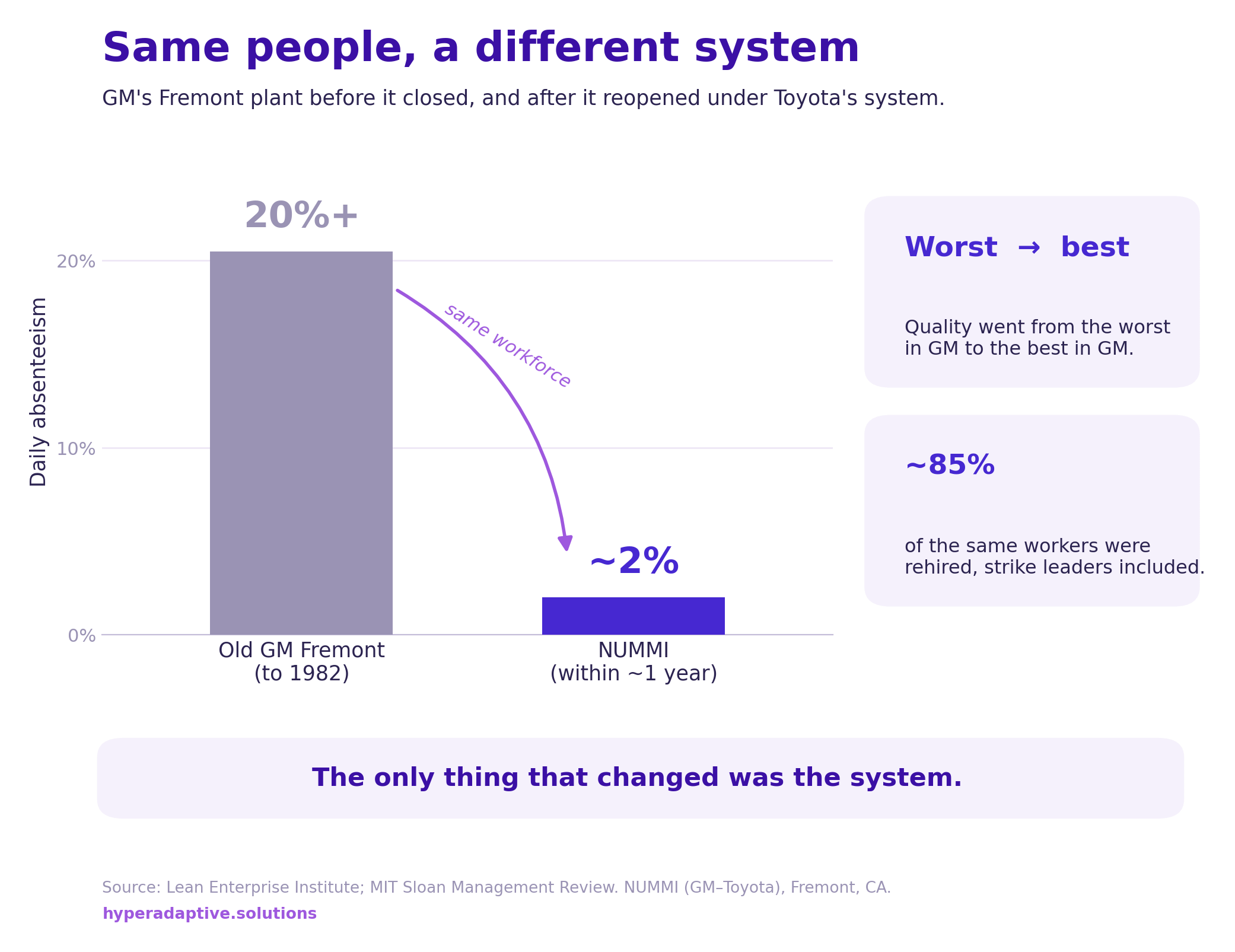
In 1982, General Motors closed its plant in Fremont, California. The plant had earned the reputation as the worst car factory in the GM system. Absenteeism routinely ran above 20 percent, meaning that on any given morning one in five workers simply didn’t show up. Quality was among the poorest GM produced anywhere. The union local was known for wildcat strikes and grievances filed by the thousand, and there are documented accounts of workers deliberately building defects into cars. Management and labor had stopped seeing each other as anything but the enemy. So GM did what a company does with a plant like that. It shut the doors and sent everyone home.
Two years later, the same building reopened under a new name, NUMMI, a joint venture between GM and Toyota. Toyota rehired roughly 85 percent of that same workforce. The absentee list, the strike leaders, the people GM had written off as the problem, most of them came back. Within about a year, absenteeism fell to around 2 percent and quality climbed from the worst in GM to the best in GM. Same people. Same machines. Same town. As the Lean Enterprise Institute later put it, the only thing that changed was the system.
I have spent a good part of my career studying that system, going back to my time learning the Toyota Production System in Tokyo. So I’ll admit that I have a soft spot for TPS. But I am sharing this story for a different reason. I believe it has applicability for this AI moment. We have handed our people powerful tools. Many are using them. And, yet…the enterprise value we were promised has largely failed to show up. The Fremont floor answers why.
Everyone is adopting AI, and value still lags.
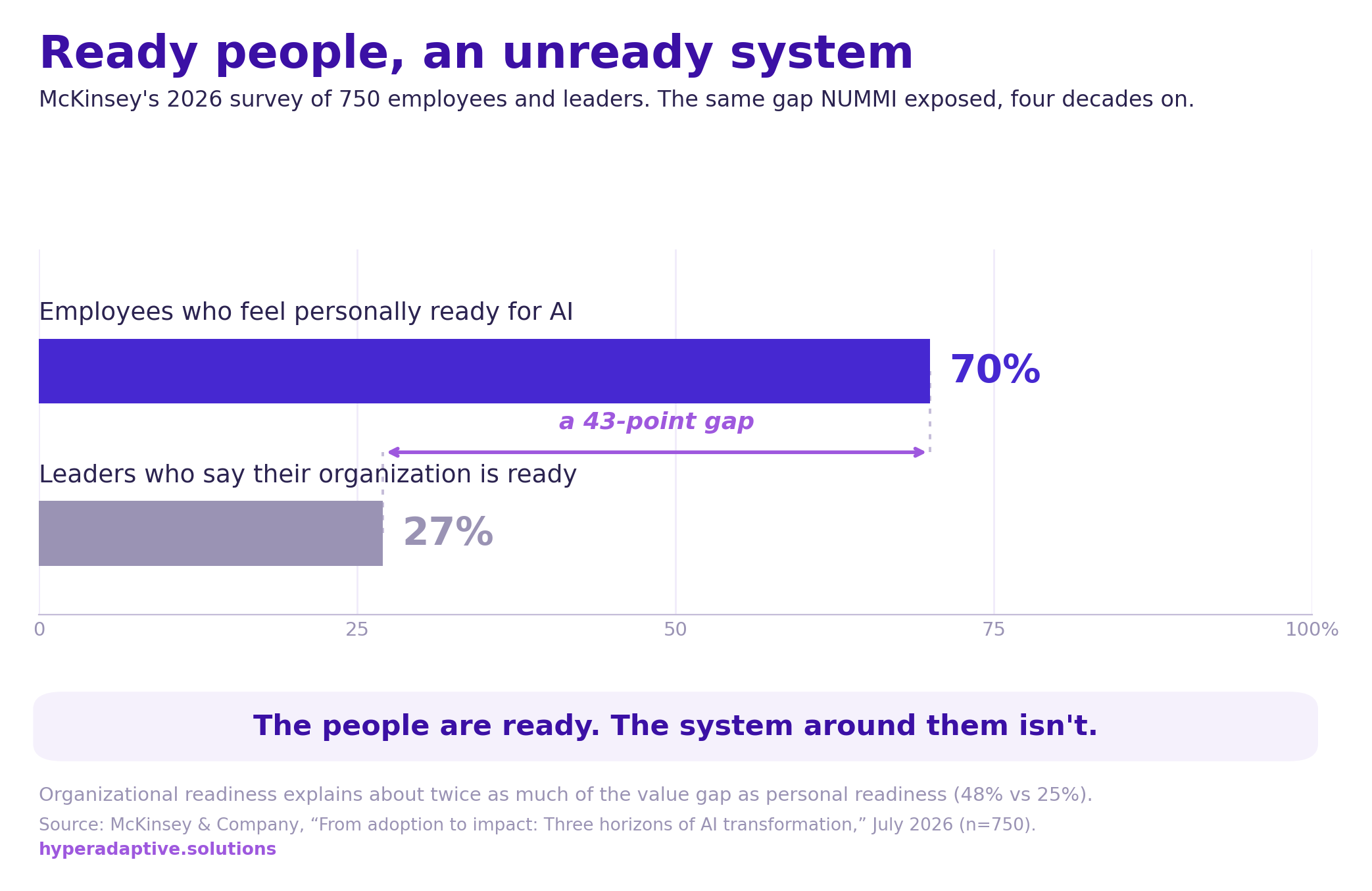
McKinsey published a global survey in July 2026 that put numbers to AI adoption. Across 750 employees and leaders, 70 percent said they felt personally ready to adopt and use AI. But…only 27 percent of leaders believed their organization was ready to make the shifts needed to actually change around it. On top of that, only 11 percent of organizations had reached what McKinsey calls reinvention (the point where work itself is redesigned rather than merely assisted). The majority of organizations, at every level of maturity, said AI had yet to deliver meaningful business value.
Then McKinsey found that organizational readiness, not personal readiness, explained the difference between the companies capturing value and the ones that weren’t.
Organizational readiness accounted for 48 percent of that difference. Personal readiness accounted for 25. In plain terms, whether your people can use the tools is real, but it is roughly half as important as whether the organization around them has changed to make those tools count.
This is the same gap that sat between old Fremont and NUMMI, without the hostility. GM had capable people the whole time. What it lacked was an organizational system that let capable people produce good work. When McKinsey says most organizations are stuck in adoption without value, they are describing a factory full of talented workers standing at the old workstations, wired to the old line, reporting up the old ladder, now holding a much better tool. The tool is not the constraint. The wiring around it is.
Building a system that supports AI is the hard part.
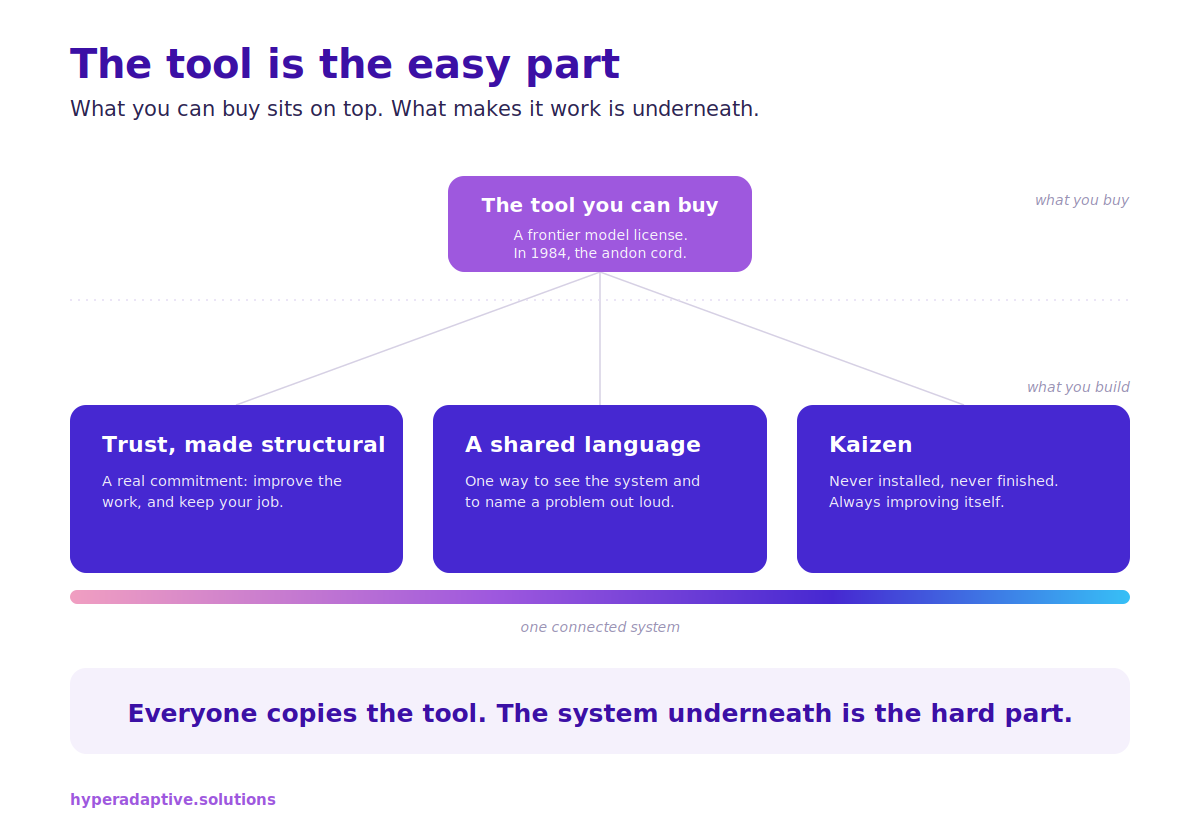
After NUMMI worked, everyone wanted to know how. GM had a front-row seat, a literal joint venture with its own workers inside a Toyota system, and it still took GM the better part of two decades to absorb what it was seeing. The tools were never the secret. The kanban cards, the andon cord that any worker could pull to stop the line, the standardized work sheets, all of it was visible and copyable. Companies copied them enthusiastically. Many got very little in return, which is exactly the story Womack, Jones, and Roos documented in The Machine That Changed the World in 1990. Western plants adopted the tools of lean and kept the system of mass production underneath, and the tools produced almost nothing on their own.
Think about this as you implement AI. The license to a frontier model is the visible tool, and it is genuinely powerful. But if you install it into an operating model built for a different era, you get activity without value. It’s also the reason I give away the Hyperadaptive Model in the book. The model holds value, for certain. But describing the model isn’t the same as implementing it.
McKinsey found that leaders were 5.3 times more likely to report enterprise value when they had actually redesigned workflows, 32 percent capturing value versus 6 percent when the workflow stayed the same. The redesign is the system. And system redesign is something that a procurement contract can’t solve.
Everything below is about the three things Toyota changed in the NUMMI experiment. I share them because they map almost perfectly onto the three places I see AI transformations stall today.
Trust is Actively & Continually Cultivated
McKinsey found that trust was the single most important readiness factor across all three horizons of maturity. Not in the early stage only. In every stage. Employees needed to believe the organization would support them through the change rather than simply expect them to absorb it. McKinsey advises leaders to communicate honestly, acknowledge what they don’t know, and follow through. All true, and so seemingly simple. And yet, when I ask leaders what their “AI North Star” is (what they hope to accomplish with AI), I am often met with uncertainty.
When NUMMI opened, Toyota made an explicit commitment that it would not lay people off to capture the gains from their own improvements. That single policy is what made the rest of the system function. Think about the andon cord for a moment. You are asking a worker to stop the entire production line when they spot a defect, which draws immediate attention and costs real money by the minute. A worker will only pull that cord if pulling it cannot be used against them. The same person who had sabotaged quality at old Fremont, because quality was management’s problem and management was the adversary, would now stop the line to protect quality, because the system had made a credible promise that improvement would not cost them their livelihood.
Trust was not a sentiment. It was a structural commitment that changed what was rational for a person to do.
Think about this through the lens of AI. Your people can see exactly what is coming. When AI can handle a million service tickets, they know what that means for the level-one role. When AI drafts the first version of the contract, the junior associate knows what that means for the apprenticeship that used to make them senior. You cannot build trust by promising nothing will change, because they will not believe you, and they shouldn’t. Some anxiety in this moment is honest and appropriate.
What you can do is make the NUMMI commitment in your own language. You can say, clearly and then in your actions, that the capacity AI frees up will be redirected and the people freed up will be redeployed, not discarded. Trust of that kind is the precondition for everyone else pulling the cord, which is to say, for everyone else telling you where the real defects and the real opportunities are. Without it, they will keep that knowledge to themselves, exactly as the old Fremont workers did.
AI needs a shared language
The second thing the Toyota Production System provides is a shared language. A Toyota floor runs on standardized work and visual management. Everyone, from the newest hire to the plant manager, could look at the same board and read the same state of the same system in the same terms. When a problem surfaced, they had common words for it, a common picture of where it lived, and a common method for improving it. That shared language is what lets improvement spread horizontally instead of dying inside one supervisor’s head.
Most organizations trying to adopt AI have nothing like it. In the book, Hyperadaptive, I outline a shared set of terms like “AI Activation Hubs, AI Impact Hubs, AI Knowledge Engine,” to standardize language and provide a shared mental model across the organization. Without this shared vocabulary, every function uses AI differently, names things differently, and measures success differently. You get a hundred local experiments and no way to compare, combine, or compound them. This is a large part of why McKinsey finds so much individual productivity that never becomes organizational performance. The wins can’t travel because the organization has no common way to describe them.
Building that shared language is unglamorous and it is foundational, which is why the first stage of the Hyperadaptive Model is about foundations before technology rather than tools first. It means a common vocabulary for what AI is doing in your workflows, a shared way to translate technical possibility into business terms, and enough baseline fluency across the organization that a redesign in one function can be read and reused in another. You are not standardizing to control people. You are standardizing so that a good idea in the claims team can be understood by the underwriting team without a translator.
Toyota Understands There Is No End State
McKinsey’s research outlines three stages, with the last being reinvention. This makes it feel like there is an end state. Toyota puts kaizen, continuous improvement, at the heart of its system. A nod that things will always be changing. NUMMI was never installed and finished. The standardized work sheet was not the final answer, it was the current best answer, posted so that the person doing the job could propose the next improvement to it. The system’s defining feature was that it never stopped changing itself. That is the actual destination, and it is not a rung on a ladder. It is a different operating state, one where sensing and adjusting is the normal condition rather than a project with an end date.
This is why I describe continuous adaptation as one of the core capabilities of a Hyperadaptive organization. It’s why I keep saying that reviews of how you work can’t be quarterly or annual anymore, they have to become continuous, with real-time adjustment replacing periodic inspection. If you treat your AI transformation as a program with a go-live date, you will fail. The pace of the technology will not sit still long enough for a finished state to hold.
What this means for AI Transformation Leaders
If you lead a function or an enterprise and you take one thing from Fremont, let it be the order of operations. GM’s mistake, for twenty years, was to skip the invisible system, assume trust would materialize on its own, and have no game plan for empowering front-line workers to reinvent their work. The same instinct is everywhere in AI right now, and it produces the same result, motion without gain.
So, where do you start? Start by redesigning one real workflow around what AI now makes possible, end to end, rather than sprinkling assistance across everything, because the redesign is where McKinsey’s 5.3 times difference lives. Make your social contract explicit and then honor it in a visible decision, so that people believe the freed-up capacity is going to be redirected and they will be redeployed. Until they believe it they will not tell you the truth about their own work. Invest early in a shared language, a common way to name and measure what AI is doing across functions, so that a win in one place can be read and reused in another. And design the whole thing to keep improving after it ships, because a transformation with a finish line is already out of date. This is the work of Stage 4 in the model, rewiring the organization, and it is worth every bit of the effort that the tool purchase was not.
None of this requires you to have all the authority in the building. It requires you to start where you sit. You become the person who notices that the operating model will not survive what is coming and begins to design what replaces it. You build the structure your organization is missing, you name what is happening out loud in the rooms where it isn’t being named, and you find the others who see it too.
Final Thoughts
NUMMI provides an interesting reference point because it is proof, not theory. It is documented, it is decades old, and it settled the question of whether the people or the system was the issue. The people were never the problem. They were the same people. What changed was a set of choices about trust, language, and continuous improvement that turned a workforce everyone had given up on into the best in the company inside a year.
That is not only a Toyota story. It is the root of a longer one. Serious people have been trying to redesign the operating model for the better part of seventy years, through lean and Six Sigma and business process redesign and Agile, and every one of those efforts did real good inside one part of the organization and then hit the same ceiling, because the industrial-age operating system underneath was strong enough to absorb the improvement and keep running. AI is the first force I have seen that the old system cannot simply absorb, because it changes the work itself, under everyone’s hands, all at once. That is what makes this moment different, and it is why the choice in front of us is real. The system is going to change either way. The question is whether it changes by accident, in whatever direction the next model release happens to push it, or on purpose, in a direction we choose.
The tools in our hands today are far more powerful than an andon cord, which means the value on the other side of the redesign is far larger, and the cost of skipping it is too. The efficiency will follow the rewiring. It always has. Our job is to build the system worth wiring the tools into, and to keep building it, together, all the way to AI-native.
How to Build the Hyperadaptive System
Building the system is what we cover in the Running Hyperadaptive Organizations class, where we bring Hyperadaptive concepts to life. You can find more information at hyperadaptive.solutions/class.
And if you want the full picture of the Hyperadaptive Model, that’s what the book is for. Hyperadaptive: Rewiring the Enterprise to Become AI-Native