What the Rise of the Smart Phone Camera Tells Us About the Future of Coding
(Or... what happened to all of the studio photographers? And will coders face a similar future? I think not.)
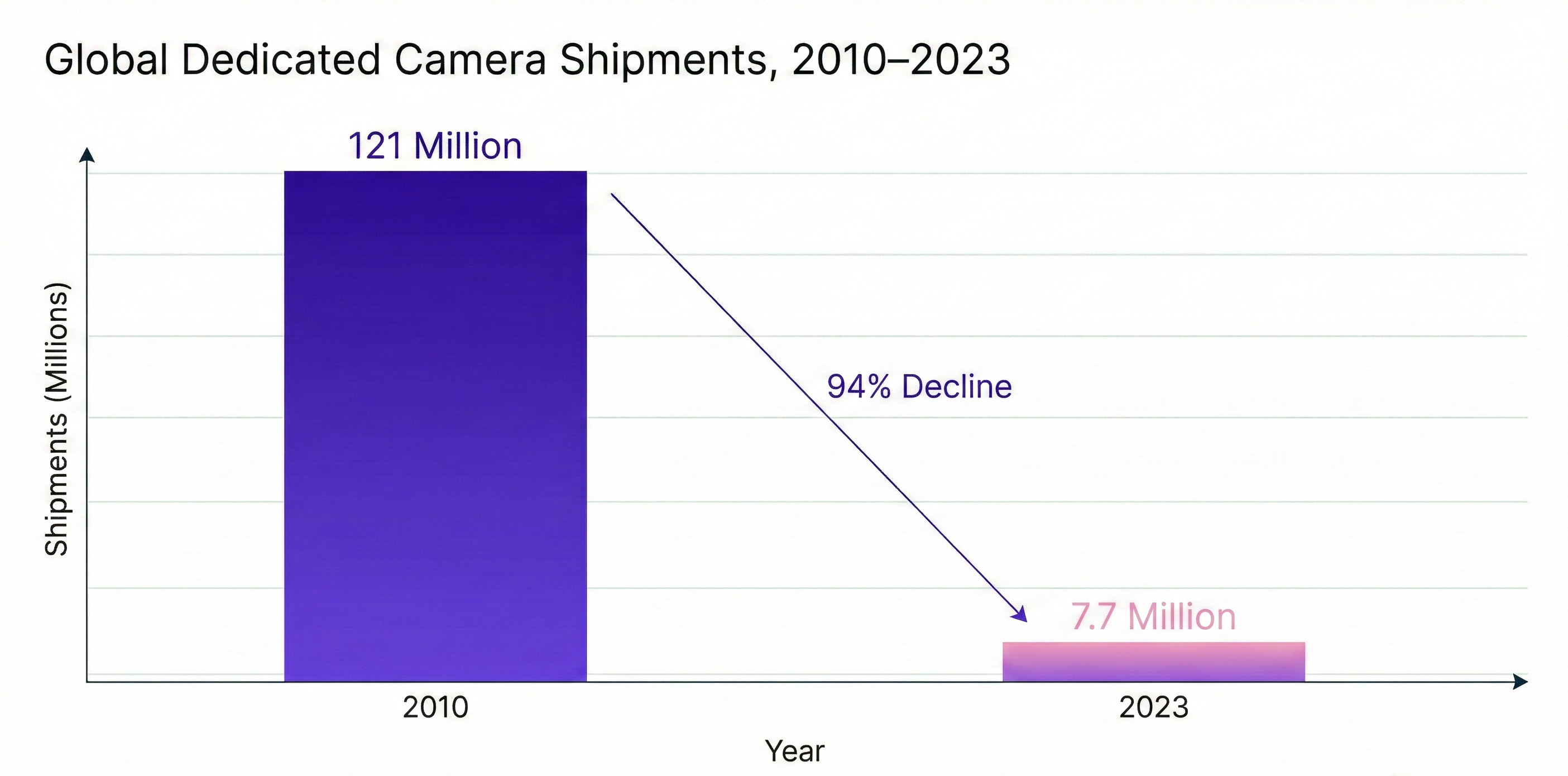
In 2010, the world shipped 121 million dedicated cameras. By 2023, that number had cratered to 7.7 million. That’s a 94% collapse in just over a decade. The smartphone didn’t just disrupt the camera industry. It vaporized the economic moat that protected an entire professional class. When smart phones automated focus, exposure, and color grading, the ability to capture a technically correct image (once an economically viable skill) became a free feature of the hardware in your pocket.
And guess what? Generative AI is doing the exact same thing to code right now.
What Happened to the Photographers?
Let me be clear about what the smartphone didn’t do. It didn’t kill photography. The Bureau of Labor Statistics still tracks the profession, and high-end commercial photographers continue to earn more than $200,000 a year. Annie Leibovitz isn’t losing sleep over your iPhone 17.
What the smartphone killed was the middle of the profession.
The local studio photographer who made a solid middle-class living shooting high school seniors, small business headshots, and weekend weddings? That world largely evaporated. Those services are now either performed by clients themselves or outsourced to gig workers competing on price in a race to the bottom. The median hourly wage for photographers in 2024 was $20.44, below the total for all occupations.
The labor market didn’t shrink uniformly. It split. The top time, including visual strategists who direct complex commercial productions where the cost of failure is high, actually thrived. The bottom tier exploded with semi-professionals willing to work for portfolio building rates. And the middle hollowed out.
The Pie Grew, But The Slice Got Thinner.
Here’s where the economics get fascinating. When the smartphone made image capture essentially free, consumption exploded. Global daily image volume went from roughly 80 million in 2000 to over 6.3 billion in 2024, a 78-fold increase. Jevons Paradox (which keeps coming up, BTW), strikes again. When you dramatically increase the efficiency of producing something, total consumption increases rather than decreases.
The digital image creation pie grew enormously. Goldman Sachs estimates the Creator Economy, which didn’t even exist in the film era, is worth $250 billion and projected to reach $480 billion by 2027.7 Ad spend in the Creator Economy alone will hit $37 billion in 2025, growing four times faster than the general media market.
But the individual photographer’s slice of that massive pie got thinner. The total economy for photos and videos expanded 10x or 20x, yet professional photography services barely grew. The value migrated away from the person capturing the image and toward the platforms aggregating content.
Now Watch the Same Movie, Different Cast
Generative AI is the new iPhone, this time for code instead of cameras. Just as computational photography abstracted the physics of light into a touch interface, large language models are abstracting the syntax of programming into natural language.
The Jevons Paradox is already kicking in. When AI reduces the marginal cost of generating code to near zero, the threshold for what warrants a software solution drops dramatically. Apps built for a single meeting, a specific campaign, and a temporary workflow start to becomes economically viable.
And the bifurcation is already visible. Hiring for entry-level developers has flattened at around 7% growth, while demand for senior technical leads has spiked 22%.
Companies are opting for smaller, senior-heavy teams augmented by AI rather than traditional pyramids of juniors.
Gartner predicts that citizen developers such as business analysts, marketers, and designers using AI-powered low-code tools will soon outnumber professional developers four to one.
The ‘citizen photographer’ with an iPhone became the dominant producer of visual content. The ‘citizen developer’ with an AI coding assistant is about to become the dominant producer of software.
From Writer to Orchestrator
The photographers who survived the smartphone revolution moved up the stack from technician to creative director, from capturing images to directing visual strategy.
Software engineers will need to make the same leap. The future role isn’t about being a coder. The future is in orchestration. Someone who defines system architecture, selects appropriate AI models, verifies security and integrity of the output, and integrates components into cohesive business solutions.
And just as deepfakes created a premium for verified, trustworthy photography, AI-generated code will create a massive premium for security and trust. Industries with high consequences for failure, such as finance, healthcare, and aerospace, will pay premiums for human-verified code. The engineer’s primary task shifts from creation to audit. Finding the subtle hallucination in an AI-generated codebase becomes the new high-value work.
This is the Hyperadaptive model in action: people move from doing the task to building, monitoring, and maintaining the AI agents that do the task. It’s not a minor tweak to a job description. It’s a fundamental rewiring of roles, skills, and organizational structures.
The Opportunities We Can’t Yet Predict
I am an optimist, so here’s what gives me hope.
When the smartphone put a camera in every pocket, nobody predicted YouTube. Nobody predicted Instagram. Nobody predicted that “Influencer” would become a legitimate career (is it?), or that major brands like Dove and Gymshark would hire professionals to make content that looks amateur. 🤯 That they would pay creators to shoot on iPhones to achieve the authentic aesthetic that Gen Z actually trusts.
The entire Creator Economy represents a category of work that was unimaginable in the film era. It emerged because ubiquitous cameras changed not just how images were made, but how they were used. The photograph transformed from a physical object intended for preservation into a fleeting unit of communication.
Software is about to undergo the same transformation. When code becomes ubiquitous, entirely new categories of work will emerge that we can’t predict today. The pie grows and spawns entirely new types of bakeries.
What This Means for AI Transformation Leaders
If you’re leading an AI transformation, the photography parallel offers a clear playbook.
Technical proficiency is becoming a commodity. Just as mastery of f-stops stopped being a differentiator, proficiency in Python or Java syntax will cease to be one. The middle will compress, just as local studio photography did.
The shift from coder to orchestrator won’t happen organically. It requires intentional role redesign, new career pathways, and robust support structures. This is significant organizational rewiring.
The durable skills such as complex system architecture, security governance, data ethics, product strategy, and the ability to bridge human intent and machine execution remain. Those are also the skills most organizations aren’t investing in nearly enough.
As you rewire, be on the lookout for emergent opportunities. The most valuable roles five years from now probably don’t have job titles yet. Build an organization that can sense and respond to them as they emerge.
The photography revolution didn’t kill visual media. It made it ambient. It wove it into every human interaction. Software is about to become equally ambient. The question becomes how will your organization respond to the shift? Will it fire all of the coder only to realize these are the same people who are best-suited to orchestrate the agents? Will it hire only high-end engineers, only to discover there is no one to take their place when they leave?
Or will you take the leap that you still need people to build, monitor, and maintain an army of AI coding agents? And take the steps needed to shepherd your people through the change?
The choice is yours.
For a comprehensive framework on how to rewire your organization for this shift, from role redesign to support structures to measurement, pre-order Hyperadaptive: Rewiring the Enterprise to Become AI-Native, publishing May 2026 with IT Revolution Press.
Relevant Articles:
Stop Generic AI Training. Start Mapping Roles to Build, Monitor, Maintain.
The Wreckage of the Factory Floor
Your Org Structure Doesn't Like AI
The sugar high of Generative AI is over.Hyperadaptive Intelligence (AI Transformation Strategies) is a reader-supported publication. To receive new posts and support my work, consider becoming a free or paid subscriber.


