Stop Generic AI Training. Start Mapping Roles to Build, Monitor, Maintain.
AI is rearranging work. The fastest way to get ahead of it is to map people to three new role types: builders, monitors, and maintainers.
The Wreckage of the Factory Floor
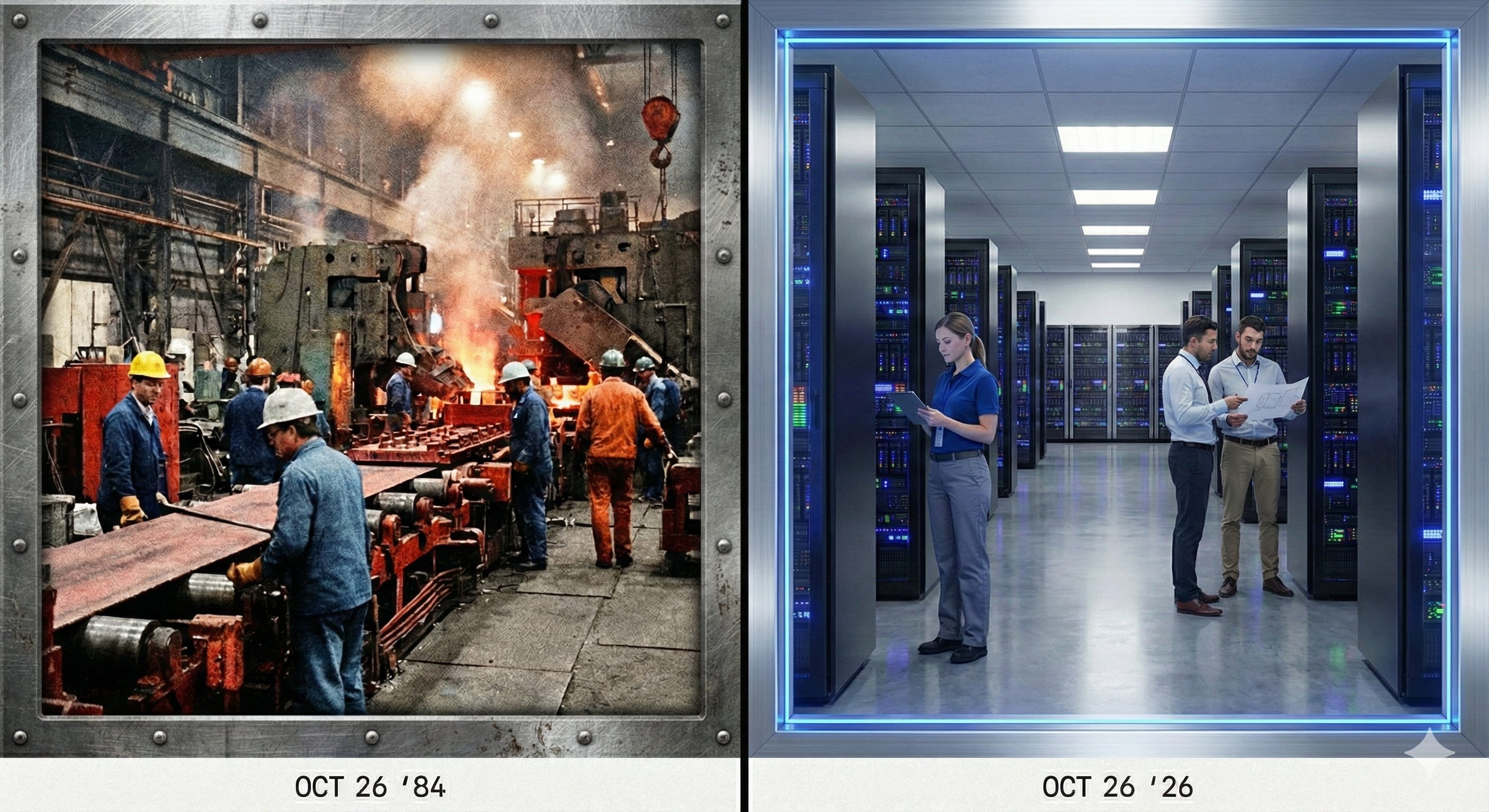
In the late 1970s and early 1980s, the American economy churned. Global competition and the emergence of free trade zones shuttered manufacturing plants and decimated entire communities. The Iron Belt rusted over, and a generation of workers who had built their identities around the blast furnace and the assembly line were left adrift.
We are still feeling the ripples of that dislocation today. But the tragedy of the Rust Belt wasn’t just that the jobs went away. The tragedy was that we, as a society and an economy, failed the transition.
We are now standing on the precipice of a similar reckoning. This time, however, it is not the blue-collar worker facing the shock of globalization; it is the white-collar worker facing the shock of cognitive automation. As Artificial Intelligence begins to take over the tasks of analysis, creation, and coordination, we risk creating a ‘Digital Rust Belt’ of displaced knowledge workers.
But history does not have to repeat itself. If we look closely at why we failed the steelworkers, we find the blueprint for how we must lead our teams through the massive Role Reshuffle of the 2020s.
The Failure of Generic Retraining for Everyone
When the factories closed, the solution proposed by policymakers and corporate leaders was retraining. We launched programs like the Trade Adjustment Assistance (TAA) and the Job Training Partnership Act (JTPA). On paper, they looked robust. In practice, they were often disastrous.
Research into this era reveals that these programs failed because they were reactive and generic rather than proactive and aptitude-based. We waited until the displacement had already occurred (often a year or more after the plant was shuttered) to begin the intervention. Worse, we fell prey to thinking everyone could be reskilled in the same way. We looked at steelworkers and tried to retrain them for the hot jobs of the era, often ignoring the fundamental mismatch between the worker’s aptitude and the new role.
We tried to turn people who possessed deep technical proficiency in welding, complex safety coordination, and high-risk project management into service workers or entry-level computer operators.¹ A better approach would have been to transfer their strengths into the growing fields of specialized construction, transportation, or utilities.
We are in danger of making the exact same mistake today.
The current corporate narrative is filled with broad, lazy assumptions. We hear that junior positions are going away or that older workers won’t lean into AI. We see companies offering generic GenAI upskilling courses to everyone, assuming that if we just give people access to ChatGPT, they will figure it out.
This is the modern equivalent of teaching a steelworker to type and hoping for the best.
The Upcoming Role Upheaval
The reality of the AI transition is not a binary split between haves and have-nots. It is not as simple as coders win, writers lose.
What is actually happening is a massive reshuffling of roles. Imagine the puzzle pieces of every job description in your company are being thrown into the air. When they land, the picture will look fundamentally different.
For the last fifty years, the value of a knowledge worker was defined by three things:
Doing the Task. Writing the brief, coding the module, creating the spreadsheet.
Following the Process. Adhering to the workflow to ensure consistency.
Making the Decision. Using limited data to make a judgment call.
In the Hyperadaptive enterprise, AI capabilities are aggressively consuming the first two, and radically augmenting the third. The AI can now do the task. The AI can now execute the process. And the AI can supplement decision-making with modeling and analysis far deeper than any human brain can hold.
So, where does the human go?
The human role shifts from doing the work to building, monitoring, and maintaining the automations that do the work.
This is the crux of the transition. We are moving from a workforce of players to a workforce of conductors. New roles architect workflows. Continually. Because this much is for certain: AI doesn’t stand still. The marketing manager moves from writing copy to monitoring a system of agents that write, test, and optimize copy.
So…Who Makes the Cut?
If the new roles focus on monitoring and maintaining (ensuring the AI is performing correctly, identifying hallucinations, and tuning the output for quality) then who is best positioned to do that?
It is the person who knows what good looks like.
The best person to monitor an agentic legal associate is a senior paralegal who has spent twenty years drafting contracts. The best person to maintain an AI coding agent is the veteran developer who can spot a security vulnerability in a split second.
As noted in my upcoming book Hyperadaptive, The best people to manage AI in a functional area are those who have been doing it for a long time.
However, this is where the friction lies. Just because a senior expert has the knowledge to monitor the system does not mean they have the aptitude or the desire to do so.
We must stop assuming that everyone will make the transition to these new roles.
Some high-performers love the act of creation. They love writing the sentence. They love writing the code. When you ask them to stop writing and start managing the writer, they may disengage.
Some junior employees may lack the domain expertise to monitor effectively today, but possess high aptitude to see workflows and logic, making them excellent candidates for building the new automations.
A key failure of the Rust Belt era was that we treated all steelworkers as a monolith. We cannot treat all knowledge workers similarly.
The Catalyst for Reinvention
This brings us to the realization everyone will make the cut. And that is not necessarily a failure.
I recently witnessed a former colleague who, facing the changing winds of her industry and endless rounds of layoffs, didn’t engage a headhunter or revamp her resume. She bought a spa franchise.
In the harsh light of the ‘AI or Die’ narrative, this may look like a retreat. But through the lens of the roles totally reinventing themselves, it is a successful act of self-selection. She recognized that her aptitudes and desires, including high-touch connection, physical presence, and tangible service, were where she wanted to place her bets. She effectively reinvented herself in a sector where AI cannot compete.
This is the nuance we missed in the 1980s. Perhaps if we had done a better job identifying a steelworker’s adjacent competencies, we could have guided them toward specializations that honored their skills. Instead, we came in after a year of demoralization set in, and taught them to type.
Our Collective Leadership Responsibility
As leaders, we have a moral and fiduciary responsibility to do better than the policymakers of the 1970s. We cannot wait for the layoffs to start before we begin the conversation.
We must shift our focus today to aptitude discovery. Lessons from the Rust Belt include:
1. Don’t Wait for the Plant Closure. The time to retool your workforce is while the factory is still running. We need to identify those with the aptitude to build, monitor, and maintain AI now, before these individuals move to somewhere they can put their skills to work.
2. Stop Broad-Brush Training. Segment your teams to identify people well-suited to new roles:
Who has the Domain Expertise to monitor quality? (Likely your seniors).
Who has the Systems Thinking to build the workflows? (Could be anyone, junior or senior).
Who is purely a Task Executor with low desire to adapt? (These are your at-risk individuals).
3. Validate Diverse Reinventions. We must destigmatize the exit. If a valuable team member realizes an AI role isn’t for them, helping them transition to a different career path, within or outside of the organization, is a better outcome than forcing them into a role where they will fail.
Taking Care of Humans in the Machine Age
The World Economic Forum estimates a net new change of jobs, not a vanishing of them. But net new is a cold comfort to the individual whose specific job just evaporated.
We are rewiring the operating system of the enterprise. We are moving from human execution to AI orchestration. The lesson from the Rust Belt is clear: The market will eventually correct itself, but the human cost of a chaotic transition can be devastating.
We have the tools to do it differently this time. We can map aptitude. We can value the deep expertise of our senior staff while harnessing the adaptability of our juniors. We can acknowledge that role rewiring will lead some people to become citizen developers and others to the spa franchise, and that both paths are valid.
The pieces are in the air. It is our collective job to help them land with a human touch.
Contribute to the Conversation
Click the comment bubble to share your take. I’ll be replying to everyone today.
For Paid Subscribers: The Role Roundtable
Next Thursday, January 29th, 2 PM EST via Zoom
Discussing role transition is messy, and it’s hard to discuss in public forums like without causing anxiety.
In this month’s Roundtable, we are stripping away the theory and looking at the reality of rewiring roles with AI.
Topic: Rewiring of Roles with AI
Format: Chatham House Rule (What is said here, stays here).
Access: Exclusive to Paid Subscribers.
Upgrade your subscription to receive the invite link and access to the full archives, monthly events, and early access to Hyperadaptive Frameworks.
Further Reading This article was heavily influenced by the implementation gap theories in Recoding America by Jennifer Pahlka and the Jagged Frontier research by Ethan Mollick If you haven't read their work, it is essential reading for this shift.


