

“Four minutes was not enough,” said one participant in our August Running Hyperadaptive Organizations cohort. It was eight. (I checked. So did the person next to them, out loud.)
Every breakout in the cohort felt too fast. Both sessions, every block. The first time I called everyone back, the report-out opened with “we were just getting into some great ideas and then, oh, the timer, here comes the timer.”
We are all thirsty for community. And doubly so when it comes to AI Transformation.
So that’s what I want to write about today. Why creating a Learning Arena is important (as Susan Adams says “the community is the curriculum”), the headwinds AI leads are facing, and where the class revealed orgs are strong and weak across the nine dimensions of the Hyperadaptive Model.
What is a Learning Arena?
When AI can generate a course faster than it takes me to write and edit an article like this (yes…I am still here!), what is left?
Each other, our lived experiences, our judgment, and our challenges.
I built the class on a hunch that the people in the room have as much to share with each other as I did, despite being the ‘teacher’ in the room. My goal was to facilitate the cohort in a way that surfaced the knowledge in the room. I call it a Learning Arena. In the room, we had:
A PMO leader at a Fortune 100 insurance company.
A VP of technology at a trucking company.
Someone standing up a brand-new AI enablement practice at a Fortune 500.
A COO at an AI startup.
AI consultants, mapping clients across five industries
Live events being live events, my timer’s music option didn’t work (I offered to sing instead, but they declined…smart!), the chat had a character limit I hadn’t tested, and one participant found a bug in the copy button. “Aha, we found a bug. Congratulations, high five.” Murphy was in the room, as usual.
Rather than being a teacher in a classroom, I was a coach in the arena, making real-time calls. By session two, I responded to the need for more time in breakouts. Ten-minute breakouts became twelve, then twenty-two. One pair chose to give each other feedback on something outside of the stated curriculum. Fine by me. Go where there is value.
Yes, we used AI. In the chat, a learner remarked “I like how you are dog fooding us.”
We used AI to do analysis, to brainstorm, to help us when we got stuck. All of it was cool, but then we brought it back to the humans to discuss the context and to challenge it. Because there is value in conversations and people’s experience that you can’t download into a machine yet.
AI Transformation Headwinds
So, how does a learning arena look in action? Let me provide the before-and-after.
The first iteration of the cohort had headwinds (derived from my own experience and research), planted on the board:
Authority disconnects
Stalled efforts
No playbook
Need for speed
Tidy, right? The original version presented these on a slide to “discuss” while learners multitasked with Slack and whatever emergency was hitting their inbox.
The learning arena invited learners to put their headwinds on the board. You know how many surfaced? Thirty seven. Directly relevant to the people in the room, from their lived experience. Here’s how they clustered:
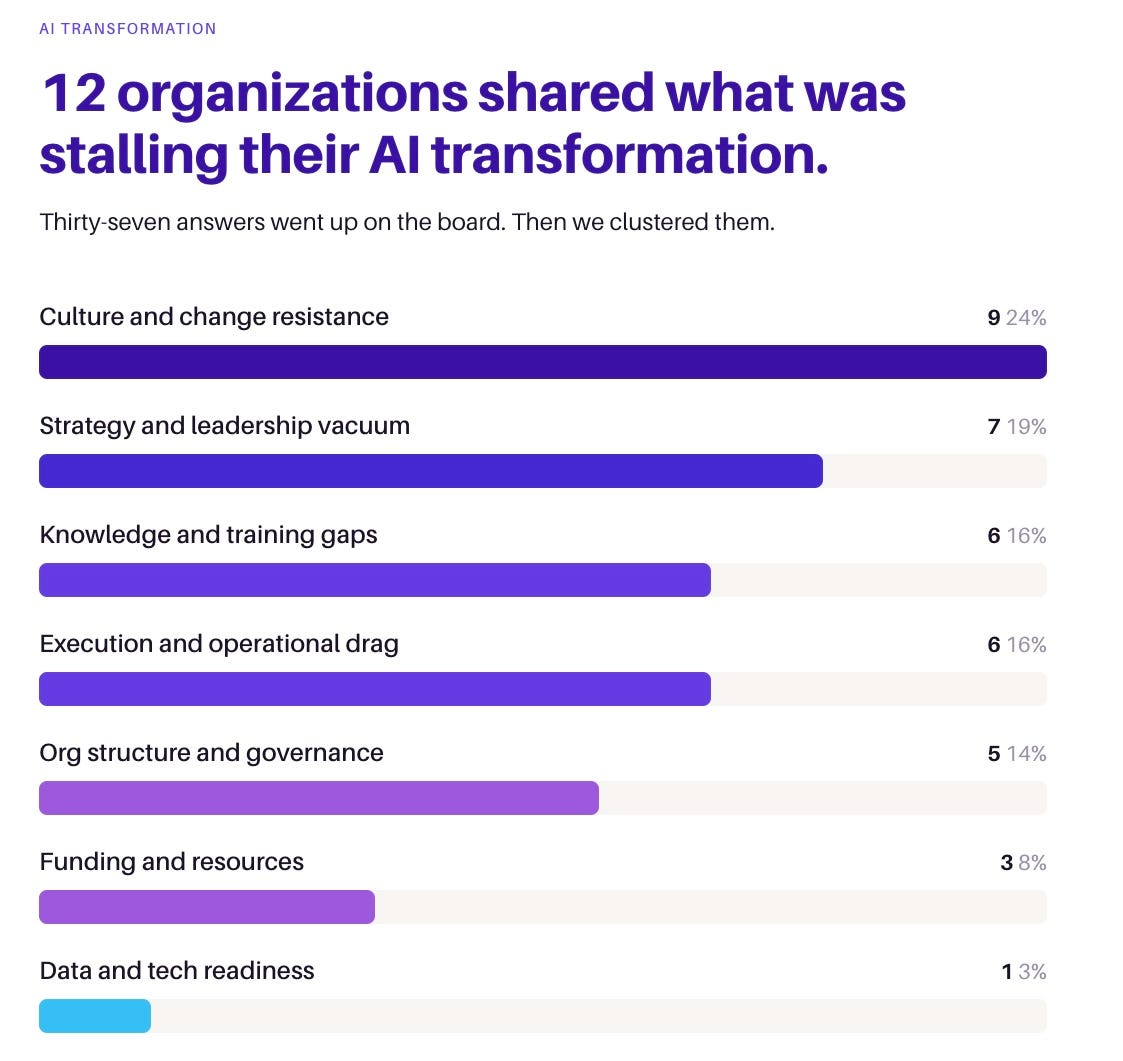
Much richer than my tidy four. Culture and change resistance, 9 notes, 24%. Strategy and leadership vacuum, 7 notes, 19%. Knowledge and training gaps, 6, and execution drag, 6. Org structure and governance, 5. Funding, 3. Data and tech readiness, 1.
And, if you notice, only one sticky about the technology. One.
Culture and leadership between them took 43% of the board, with stickies like “reactionary decisions” and “funding” and “org chart.” Everyone keeps asking why AI is stalling out. Maybe they should ask this group.
The stories behind the stickies, in their words:
A consultant, on a state-government client: “Let everybody have access, and let’s see what kind of great things they can do. And the great things that they can do turn out to be things like… have it proofread my emails. And then I don’t touch it the rest of the day.”
A technology partner at a fintech, on customer support: “There’s probably 20 or 30 POCs that are essentially trying to do the same thing.”
A marketing leader running pilots across every function: “a whole lot of seeds that are just kind of being watered, but nothing’s actually germinating.”
And one enterprise where only the developers had been given AI access, so the wins were happening in a black box the rest of the company couldn’t see.
Every one of these organizations had plenty of AI running. I told the marketing leader she wasn’t alone and that I have a name for it: random acts of AI.
The surveys say this room is typical.
Gartner found 27% of executives have a comprehensive AI strategy.
Gallup put “leadership has communicated a clear plan” at 22% of employees.
Microsoft got 26%.
BCG got 33%.
Four surveys pointing at the same thing. Most people holding an AI mandate are holding it without a plan above them, and working around that behind the scenes. One PMO leader described her version: “When people say no to me, I interpret it as not now.” (She has about 250 grassroots people riding along. Two hundred and fifty!)
What else surfaced: Where orgs were strong and weak across the nine dimensions
As part of the first session, participants read their AI Terrain using a voice assessment that scored an organization across nine dimensions on a five-stage scale, and then pressure-tested their answers in real time. (“Is this evidence your leadership would accept as proof?”)
AI Impact (think the effect AI is having on the org) came in highest, 2.0 on average. Adaptation and Learning (systematic, integrated learning loops, embedded in processes) came in lowest, 1.13. Every organization sat at Stage 1 on the Linear Organization (the impact AI has had on org design) dimension.
This points to impact without spread, where there are plenty of pilots producing plenty of results, and the learning stays in the team that built it, in an org shaped the way it was before AI showed up. That is what random acts of AI look like as a number.
The app is a starting point and you get to argue with the read, and people did. A COO said, “Wait a minute, that’s my number? Really? I want to push back.” An AI enablement lead whose company scores well on every other maturity assessment: “We actually score pretty cruddy on this assessment,” because the other assessments never ask about decision-making or learning.
The headwinds and the assessment informed session two, where we identified one ‘move’ they could make as a next step.
The move could be a decision, an action, a funding request. We worked our moves individually and as a group, pressuring testing it. Where does it die? Who kills it? Of the eleven moves that came back, seven were about influence. Getting a yes from someone whose box on the org chart you don’t sit in.
A facilitator, watching the rest of the room read its scores, asked, “Wouldn’t it be cool to run this with a group of senior executives from the same organization, at the same time, in the same room.” I agree. A powerful way to get alignment on where the growth areas and blockers reside.
The Next Cohort is In October
October 6 and 13, two mornings, fifteen seats, and it’s a powerful way to understand where your organization is at, what move to make, and connect with others in your role. Details at hyperadaptive.solutions/class.
“Make sure that your next move is going to really move the needle on what is your prime problem.”John Ford, Business Productivity Consultant
Get the full story (45 seconds):
Sources & Further Reading
Gartner: only 27% of executives have a comprehensive AI strategy (May 2026)
Gallup: 22% of U.S. employees say leadership has communicated a clear AI plan (June 2025)
Microsoft 2026 Work Trend Index: 26% of AI users see leadership aligned on AI strategy
BCG AI at Work 2026: 33% of frontline employees find leadership AI communications clear
What stood out to me is the gap between local AI success and organizational learning.
A team can discover a better workflow, a useful exception rule, or a new way to divide work between people and AI — but if that learning stays inside the team, the organization itself has not really adapted.
It makes me wonder whether one of the key operating questions is not just “what did this AI initiative achieve?” but “what did the organization learn from it, and where does that learning go next?”
Otherwise we may end up scaling pilots without scaling understanding.